Tuesday, July 16, 2013
All good things...........
Hi everyone! It's been a long time since I posted here and...... well........ it's going to be much longer now. I've decided, after months of inactivity, to officially retire Another World Of Sound. It was a blast, and I'm pleased that a lot of folks (ranging from fellow bloggers to random fans to the musicians themselves) appreciated my words and possibly found some new bands they love thanks to me. As a nice bonus, I got to see some of the out-of-print things I reviewed (Pyrolator's INLAND, Patrick Vian's BRUITS ET TEMPS ANALOGUES, the entirety of Groovy Records' output... that's just a few!) receive an official release; while I doubt I had much to do with any of that, it was a pleasant surprise to see these things be available for readers who wanted to hear'em! I never wrote here for anything but to give an opinion on the music I love; thanks to all of you for being a willing and receptive audience. If you want to stay in touch, don't hesitate to contact me via Facebook or RateYourMusic; the latter is where I spend a lot of my time now, mostly making lists. Please note I'm not deleting the blog, so there may very well come a time when I feel the same creative spark that led to its creation in the first place. Until then, it's been a wonderful time and thanks again!
Yours truly,
Prof. ~.a.~
http://rateyourmusic.com/~dotadot

Monday, November 26, 2012
Charles Tyler, CHARLES TYLER ENSEMBLE and EASTERN MAN ALONE
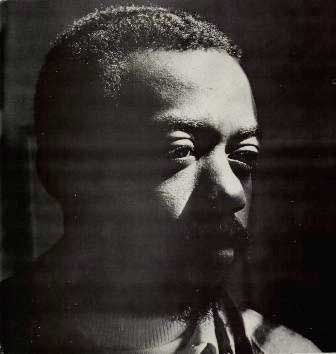
ESP-Disk', 1966; available
4 tracks, 34:02
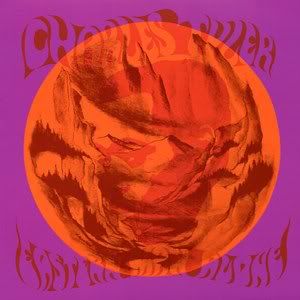
ESP-Disk', 1967; available
4 tracks, 48:24
The late great Charles Tyler was one of the underrated titans of free jazz. Having done work with everyone from Albert Ayler (on BELLS and SPIRITS REJOICE) to Rudolph Grey's Blue Humans (sadly unrecorded), he was renowned as a ferocious baritone saxman*. Curiously, he chose to play alto instead for his first two outings as a leader. CHARLES TYLER ENSEMBLE, the first of these, is also one of his most intense. For this record, Tyler assembled an impressive cast of well-known players (drummer Ronald Jackson**, drummer Charles Moffett on "orchestral vibes" for two tracks, and bassist Henry Grimes) as well as the obscure Joel Friedman on cello. Over the four tracks, Tyler and company indulge in a particularly exciting style of potent jazz. Opener "Strange Uhuru" is probably the most sedate, with Moffett's vibraphone adding an interesting touch. The intensity increases for "Lacy's Out East" (possibly a reference to Steve Lacy, but Lacy was also Tyler's middle name), "Three Spirits", and especially "Black Mysticism". Grimes and Jackson make for an impressive rhythm section, while Friedman's cello adds a unique touch of string insanity. Ayler himself was never quite this severe! It all adds up to a fine early ESP offering, highly recommended to any fan of the label or free jazz in general.
Curiously, for his second outing, Tyler took a mellower and completely different approach. Gone are the drums and the sidemen from ENSEMBLE. Instead, EASTERN MAN ALONE presents a unique quartet of Tyler, cellist David Baker, and bassists Kent Brinkley and Brent McKesson. With the change in instrumentation came the remarkable change in sound, especially apparent on opener "Cha-Lacy's Out East". Taking the basic theme of ENSEMBLE's "Lacy's Out East", Tyler and company radically rearrange it into a nearly raga-styled treasure of string interplay and sax accents. Also notable is the length of the pieces; closer "Eastern" is the shortest at 10:56, while the others are over the twelve-minute mark! "Eastern" is also the most free-form of the bunch, with every player seemingly going off on a different direction from the rest. "Man Alone" and "Le-Roi" (the latter written by Baker) follow "Cha-Lacy's Out East"'s lead, taking a modal and peaceful style of following a theme with minor improvisational elements in the middle. This might be a confusing listen after the intense ENSEMBLE, but it's every bit as accomplished and delightful. In fact, I usually play one after the other, with EASTERN MAN ALONE providing some soothing relief after ENSEMBLE's onslaught.
Tyler would continue to record until his death in 1992, but he didn't lead a group again until 1974's VOYAGE FROM JERICHO. All of his work comes highly recommended, but these two ESP albums might possibly show him at his best and most innovative; another highly original outing is 1976's SAGA OF THE OUTLAWS, an impressive one-composition epic that clocks in just ten seconds short of thirty-seven minutes.
*Tyler also founded the independent Ak-Ba label, which has been mentioned here before since it was the label that released Arthur Doyle's ALABAMA FEELING.
**Later known as Ronald Shannon Jackson, he was especially known as the drummer for the crazily powerful Last Exit, which also featured Bill Laswell, Sonny Sharrock, and Peter Brötzmann.
Wednesday, May 2, 2012
Giuseppi Logan, THE GIUSEPPI LOGAN QUARTET
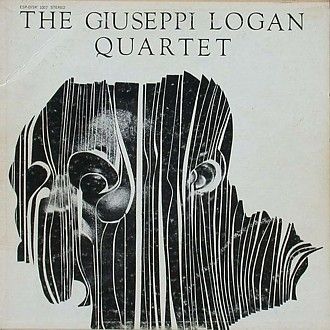
ESP-Disk', 1965; available
5 tracks, 48:10
The enigmatic Logan was long the source of mystery. He recorded two albums for ESP as a leader*, performed a bit as a sideman, and then disappeared for about forty years. He was discovered alive, well, and playing in a park in 2008, even though general opinion was that he had passed away. This album is his first ESP recording, and it's a gem! The other three players are pianist Don Pullen, bassist Eddie Gomez, and legendary free drummer Milford Graves. Logan tackles five instruments: alto and tenor saxes, bass clarinet, flute, and "Pakistani oboe". His playing style comes from a different place than Ayler's et al; there's not much spiritual or folk influence. Most of Logan's lines sound like they came from Indian, Asian, and Middle Eastern music. This is especially pronounced on the opening "Tabla Suite", the strangest composition here. Graves performs innovative improvisations on the title instrument, while Gomez and Pullen go along their own respective paths. Logan blows freely and sinuously on what I assume is the oboe, somehow following along with the others while remaining absolutely free of structure. The remaining tracks are much more in traditional free jazz territory; however, they're amazing examples of the genre. "Dance of Satan" and the lengthy "Bleecker Partita" are especially noteworthy for their catchy leads and descents into a sort of controlled improvisation that's uniquely Logan's. Highly recommended to jazz afficianadoes; anything else by Logan is worth a listen too. Logan also provides excellent sideman duties on Patty Waters' COLLEGE TOUR and Roswell Rudd's EVERYWHERE; the latter has an interesting version of "Dance of Satan".
*Actually, he recorded a third unreleased album leading a classical-influenced string-heavy ensemble. One of these days this might be released; it certainly sounds intriguing!
Wednesday, March 28, 2012
Henry Flynt, RAGA ELECTRIC
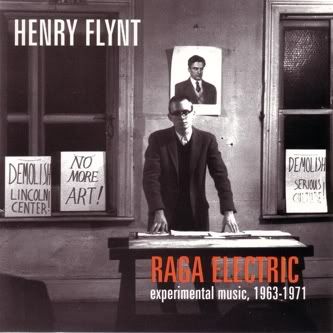
Locust, 2002; available
7 tracks, 32:42
I'm back! I had to focus on schoolwork and other life events for a bit; did you miss me? Well, even if you didn't, expect updates more frequently and now on to the review!
The works of Henry Flynt aren't for the faint of heart. It should say a lot that he's probably best known by music fans for being kicked out of the Velvet Underground for daring to play Appalachian-style fiddle! Most of his recorded work is an avant-garde take on hillbilly and/or raga music, with a few rock and tape music albums as well*. As is often the case, most of these works have seen the light of day via archival releases such as this one. Collecting some experimental works from 1963 to 1971, RAGA ELECTRIC is some of the most intimidating Flynt on record. Well, for the most part anyway. Opening track "Marines Hymn" (1971) is a genuinely trance-inducing raga take on the classic military tune, performed on acoustic guitar and chanted vocals. This track is actually one of Flynt's prettiest, but it sure doesn't prepare you for the rest of the disc! The four "Central Park Transverse Vocal" pieces (1963) are exactly that: weird avant-vocalisations recorded in the titular tunnel. As crazed as they are, "Raga Electric" itself (1966) is absolutely insane! While musically it is a genuine raga performed on what seems to be multi-tracked electric guitar, Flynt's vocal performance defies most attempts at categorization. Shrieks, howls, chants, and general weirdness is the order of the day, and the resulting performance can be terrifying or laughable depending on mood. Fans of Ono and Galas could very well consider Flynt their male counterpart based on this performance. Finally, the epic-length "Free Alto" (1964) is self-explanatory. While a bit long, it does have some interesting squeals and skronks that make it worth hearing. This is a great collection with some interesting tracks, but the intense and abstract nature of the program doesn't make for everyday listening. Check out some of the albums in the footnote if you're a Flynt newbie and then pick this up; he really is an acquired taste.
*Other Flynt albums I can recommend are I DON'T WANNA, a lo-fi proto-punk gem with a full band (the Insurrections); C TUNE and PURIFIED BY THE FIRE, each of which is a forty-plus minute wonder of violin and tamboura raga; and the self-explanatory HILLBILLY TAPE MUSIC. These aren't nearly as intense as RAGA ELECTRIC and might make a better starting point.
Monday, January 30, 2012
Cluster, CLUSTER 71
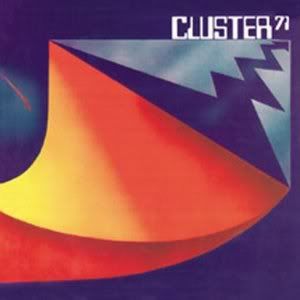
Also referred to as simply CLUSTER; the Bureau B reissue uses this title, while the Water reissue and others use CLUSTER 71
Philips, 1971; reissued several times, most recently by Water and Bureau B; available
3 tracks, 44:29
The duo of Hans-Joachim Roedelius and Dieter Moebius probably need no introduction. Having started out in Kluster with legendary sound sculptor Conrad Schnitzler* and equally legendary producer/audio manipulator Conny Plank, they continued on as Cluster with a C. While they would eventually explore all manner of electronic music (including albums with Brian Eno and Harmonia, a collaboration with Neu!'s Michael Rother), their debut finds them in a distinctly cosmic drone space. The tracks are titled "15:33", "7:38", and "21:17". Needless to say, this is also their respective lengths! The really neat thing is, much like Klaus Schulze's IRRLICHT, not a single synth was used on this album. Instead, Roedelius and Moebius create their fascinating bleeps and drones using organs, tone generators, Hawaiian slide guitars, cellos, found objects such as alarm clocks, and various effects pedals. Alternately forboding and relaxing, this is true space music that doesn't stay in one place for long while also not devolving into a noisy free-for-all (not that there's anything wrong with noisy free-for-alls!). These tracks were apparently improvised, but they have noticeable patterns and progressions that make for an engaing listen. Part of this is due to Conny Plank's production, which manipulates the sounds in real time. Plank was essentially the third member for this album. I personally consider this the essential Cluster purchase. Their later albums tend to be a bit different; CLUSTER II is the closest in spirit to 71, even though its use of synths makes for a notably different sound. Other albums can be anything from electro-dub to Kraftwerky synthpop. Also recommended is the previously mentioned Harmonia.
*Check back soon for a review of the three-disc box set, containing Kluster's KLOPFZEICHEN, ZWEI-OSTEREI, and ERUPTION!
Thursday, January 19, 2012
John Coltrane, THE OLATUNJI CONCERT: THE LAST LIVE RECORDING
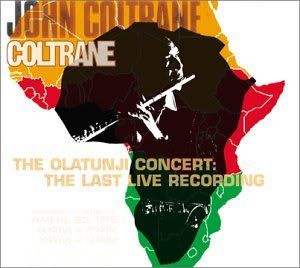
Impulse!, 2001; available
3 tracks, 63:46
While the late John Coltrane needs no introduction, this album definitely deserves a better reputation. Taking up tenor and soprano sax, Coltrane is accompanied by drummer Rashied Ali, pianist (and wife) Alice Coltrane, Bata drummer Algie DeWitt, bassist Jimmy Garrison, Pharoah Sanders on tenor sax, and a percussionist who was possibly Jumma Santos*. This show was the first of two concerts performed on April 22 of 1967 at New York's Olatunji Center. After a brief introduction by Billy Taylor, the group launches into an extended free-form version of "Ogunde". Based on an Afro-Brazilian folk tune, it's completely ferocious high-energy jazz. Coltrane and Sanders trade screeches and fluid lines, with Sanders providing most of the former. Alice and Garrison do a good job, but admittedly the rough recording quality makes a lot of their contributions inaudible. The three percussionists, on the other hand, are VERY audible throughout. The constant crash of standard kit drums and exotic percussion never lets up, and by the time "Ogunde"'s twenty-eight minutes are over, you wonder how it could possibly get more intense. A brief respite comes with Garrison's extended introductory bass solo on "My Favorite Things". This mellow rhythmic excursion is soon transformed into an extended (34:38 with the bass solo!) version of that old chestnut. Don't expect this to be ANYTHING like the "My Favorite Things" you know! This is easily one of the most intense performances caught on tape, and by the time it's over you wish the second show of the day (and the May 7th concert, Coltrane's last) had been recorded. Unfortunately, the previously mentioned audio deficiencies have cast a negative light on this album. Most listeners have complained it's bootleg quality; well, this was recorded for a radio broadcast and not for general release. I personally think the sound quality adds to this particular recording's ferocity and energy, and wholeheartedly recommend it to free jazz fans.
*Yes, the credits say "possibly". Nobody seems to remember if this percussionist was Jumma Santos or somebody else, but the odds are in Santos' favor.
Tuesday, December 20, 2011
Jack Ruby, JACK RUBY
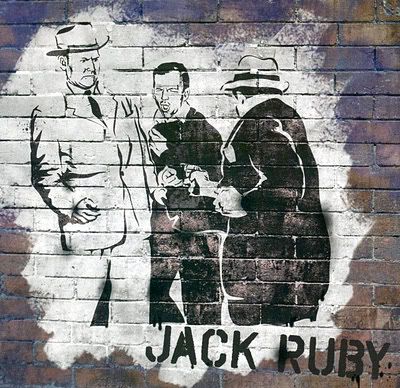
ugEXPLODE, 2011; available
8 tracks, 24:51
Since it's almost time to say goodbye to 2011, I hereby declare this short CD archival release of the year! The legendary (and until now unheard on record) Jack Ruby was a strange meeting of minds. On the first four tracks, they are comprised of singer Robin Hall, bassist/guitarist Chris Gray (the only constant, it seems), and drummer/keyboardist/Serge synth player Randy Cohen. On the first track, 1974's "Hit and Run", this trio is joined by early member Boris Policeband* on electric viola (the credits say violin, but Robin Hall himself corrected this in the comments). "Hit and Run" is a wonderful slice of proto-punk, beginning like a perfect emulation of RAW POWER-era Stooges before Hall's deranged mantra of "And ya hit and ya run and ya hit and ya run...." leads into a meltdown of Serge noises, a mess of violin feedback, and guitars distorted beyond recognition. This puts them firmly as a proto-no wave act as well. The other three '74 tracks are no less intense, with the glam-punk of "Bored Stiff" and the noisy "Bad Teeth" being highlights. The last four tracks come from a 1977 rehearsal session. The band 's lineup has been changed to future Contortions bassist George Scott, drummer Nick, and Gray, with the latter taking on vocal duties. The sound quality is a little rougher, but that's not surprising as the earlier tracks were studio-recorded demos. "Hit and Run" and "Bored Stiff" show up again, but in drastically different forms. These tracks are more in line with punk and no wave, ditching the glam touches. It might be less surprising in context, but the musicianship is still top-notch and noisy in the best ways. Comparing the two lineups is interesting, and the two halves form a delightful whole. While the playing time is admittedly skimpy, the musical quality is worth every penny. I highly suggest spending the $10 to order this direct from ugEXPLODE. Kudos to Weasel Walter for continuing to find and release no wave obscurities like this!
*Apparently three tracks were recorded with Boris; why these weren't included is unknown, but it's highly possible the tape was damaged or the recording was otherwise unsalvagable. Weasel Walter mentions having access to other Jack Ruby recordings, but it's hinted that the most noteworthy made it onto the CD.
Wednesday, November 16, 2011
Karlheinz Stockhausen, AUS DEN SIEBEN TAGEN
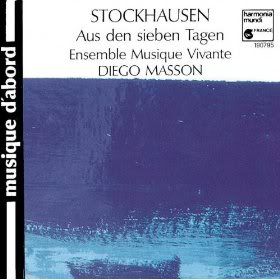
Harmonia Mundi, 1969; available
2 tracks, 46:19
The late Karleheinz Stockhausen recorded this series of pieces after a long depression. Two are represented here; I'm not sure if they're different versions than those on the seven-LP (!) box. AUS DEN SIEBEN TAGEN (ON THE SEVENTH DAY) is a classic of intuitive music. Stockhausen gave his musicians instructions on how to play (based on mood, interpretation, and other non-notational methods) and then let them take flight. Jazz guy Michel Portal sits in on various instruments (bass clarinet, tenor sax, E flat clarinet, bass clarinet, basset horn, and taragod); the other musicians, mostly French avant-gardists (it was recorded in Paris), play everything from electronium to tam-tam to darabuka. Stockhausen himself controlled the filters and potentiometers, used to distort and manipulate the sound of certain instruments. Both pieces, "Fais Voile Vers Le Soleil" ("Look Towards The Sun") and "Liaison" ("Connection"), are wonderful examples of guided intuitive improv. There are long stretches with few instruments being played as well as noisy clusters. I consider this a nice preview of the mega-set, which contains all eleven compositions (some in multiple takes). However, as a standalone album this two-track distillation is a perfectly great addition to any avant-composition collection.
Monday, October 31, 2011
Alternative TV, THE IMAGE HAS CRACKED
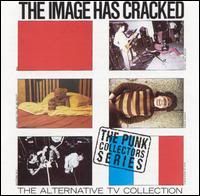
Deptford Fun City, 1978; reissued by Cherry Red with bonus tracks; available
CD: 20 tracks, 73:34
ATV founder (and mainstay) Mark Perry was the editor of the legendary punk zine SNIFFIN' GLUE. That being said, it's obvious he viewed punk more as an attitude than a sound, for Alternative TV rarely ever stuck to punk's "rules". The early singles "Life", "How Much Longer?", and "You Bastard" (all present, with the latter two appearing in different versions) are most definitely UK '70s punk, and fine examples at that! However, the debut single "Love Lies Limp" is decidedly reggae-influenced. THE IMAGE HAS CRACKED, their first album, veers all over the place stylistically. Some tracks were recorded in a studio, while others are either straight live takes or what appear to be collages of studio and live material. The straightforward punk rock of "Action Time Vision" and "Viva La Rock and Roll" are musically quite accomplished, but the experimental material makes thems somewhat tame. Opening track "Alternatives" starts with a synthesizer noodle (played by Jools Holland!) before going into a krautrocky instrumental track accompanied by Perry trying to get the audience to use the stage as a forum. He gets progressively angrier at them for acting up, finally exploding when a fight breaks out. There's also the interesting cover of Frank Zappa's "Why Don't You Do Me Right" and the hypnotic "Splitting In Two". My personal favorite is the atmospheric "Nasty Little Lonely", which has a nice slow buildup to an explosive release. One of the bonus tracks, "Another Coke", is a live number recorded for the album but rejected due to space. As a whole, THE IMAGE HAS CRACKED is a bit schizophrenic, but it does cohere into a great early post-punk album with repeated listens. After this, Alternative TV would shed their few "punk" tendencies and go deep into experimental music. The bonus track "The Force Is Blind" is much more in line with this industrial direction. It's hard to find, but the second album VIBING UP THE SENILE MAN especially shows this side of the band to great effect.
Wednesday, October 26, 2011
Pytolator, INLAND
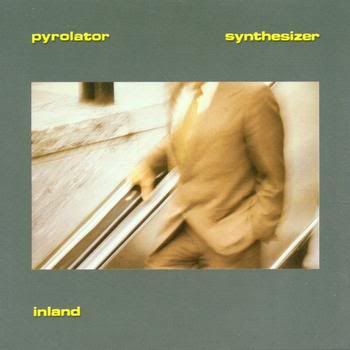
Ata Tak, 1979; available with bonus tracks
CD: 18 tracks, 59:48
Kurt "Pyrolator" Dahlke began his career in Deutsch Amerikanische Freundschaft (specifically on PRODUKT DER...) and ended up dividing his time between his solo work and Der Plan. This, the second release on the Dahlke-founded Ata Tak (again, after PRODUKT DER...!), is his first solo venture. Unlike the later AUSLAND, this finds Pyrolator completely on his own. His arsenal of machines is quite impressive - an early Italian synth, an organ, a Korg MS20, two mics, and a tape setup. Interestingly, this completely instrumental album was intended as a protest piece against prevailing cultural views in Germany! The pieces themselves cover a lot of ground in a krautrock-influenced industrial way. The four "Inland" tracks, as well as "Minimal Tape 1/2.3", are surprisingly harsh masterpieces of early synth noise. On the opposite side of the spectrum, there are the dreamy ambient "Minimal Tape 1/8" and a couple of catchy synthpop numbers (my favorite of these is "Danger Cruising", which sounds remarkably like its name). "Bärenstrasse" and "Nordatlantik" round out the stylistic diversity with pioneering bits of dark ambience. The six bonus tracks are very worthwhile as well, with the droning "Die Einsamkeit Des Langstreckenläufers", "Struktur 01" and "Struktur 22" being particularly delightful. Most of these were recorded prior to INLAND, but soundwise they are along similar lines. While this is much more minimal (and nowhere near as lighthearted) than anything else Pyrolator ever did, it's a wonderful and enjoyable slice of eccentricity. It's also my favorite Pyrolator solo release, but nervous fans might want to start with AUSLAND or Der Plan's GERI REIG before going INLAND.
Subscribe to:
Posts (Atom)