Sunday, October 18, 2009

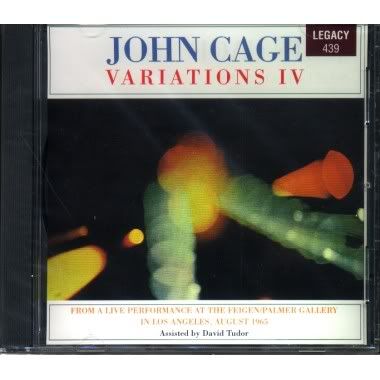
John Cage, VARIATIONS IV


Legcay, 2001; available

7 tracks, 65:29

It's strange that John Cage recordings exist, considering his disdain for recordings in general. Yet here it is, two volumes of a recording of one epic performance, edited down into just over sixty-five minutes and combined on this CD. Assisted by David Tudor, Cage set up a very complex audio system in the Feigen/Palmer Gallery in Los Angeles. I'm not exactly certain on what was done here, but records and sounds picked up by ambient microphones do come into play, as do radio broadcasts. In the end, the result truly is better heard than described, sounding like where musique concrete, plunderphonics, and chance composition combine. If this review seems rather short and not overly descriptive, it's because this truly is a difficult experience to capture in words. Go find it and hear it and you'll understand.

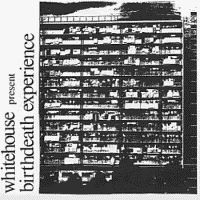
Whitehouse, BIRTHDEATH EXPERIENCE


Come Organisation, 1980; reissued by Susan Lawly; available, but tends to go in and out of print

6 tracks, 32:49

With this short album, Whitehouse were introduced to the world. At this stage, Whitehouse was William Bennett, Peter McKay, and Paul Reuter (this would be the lineup for TOTAL SEX and BUCHENWALD as well). Nowhere near as abrasive as the Bennett-Best-Sotos years, this may be the only Whitehouse album that could be called "charming" without any sense of irony. The comparitively minimal nature of this album is reflected by the equipment used: two EDP Wasp synths (legendary for their unique sound and mercurial nature, and one of which was modified by Throbbing Gristle's Chris Carter), a tone generator, and an Electro-Harmonix Memory Man. "On Top" begins with some low feedback and squiggling synth noises, soon joined by Bennett's heavily reverbed vocals. His delivery is far less intense than it would later be, and he actually sounds slightly meek at times! The music, however, is anything but tame, constantly and subtly mutating over the six minute duration. Oddly enough, four out of the six tracks are just over six minutes; whether this was intentional isn't certain. "Mindphaser" has Bennet's vocals much lower in the mix, buried under a fuzz-and-feedback drone. On this track, that works to his benefit. He keeps intoning for the listener to "relax/elax/listen to the master/you like that/FEEL THE PAIN/and pleasure" etc. etc., and the effect is DEFINITELY not as unsettling now as it may have been twenty-nine years ago, but it's still an interesting (if flawed) track. "Rock and Roll" closes side one with some random yet strangely musical explorations, held together by the tone generator's steady pulse. Over this, Bennett delivers the album's most intense vocal performance, screaming his anger at the fallacy of rock for all to hear. Side two features another three songs in a similar vein. "The Second Coming" sounds like the best parts of side one combined, while "Coitus" is the noisiest track on the album. Then there's the title track, which closes the album and is the shortest track at three and a half minutes. It's also completely silent, not even containing the sound of tape hiss or vinyl playing. Whether this is a waste of space or a stroke of genius is up to the listener, but after playing this album it's certainly not unwelcome! As stated above (and as most of you probably know already), Whitehouse would go on to become one of the harshest groups in electronic music, coining the term "power electronics" and delivering such endurance tests as ERECTOR and MUMMY AND DADDY. BIRTHDEATH EXPERIENCE is a crucial look at their early years, even if it is rather tame by their later standards. It's also worth hearing to see how Whitehouse were influential in their own way on later strains of industrial and noise music.

Thursday, October 15, 2009

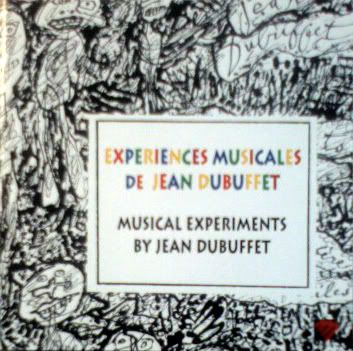
Jean Dubuffet, EXPÉRIENCES MUSICALES


Mandala, 1996 (see review); availability uncertain

9 tracks, 75:19

While mostly known as a visual artist and coiner of the term "art brut", Jean Dubuffet made some very strange recordings as well. This compilation is something of a "best of"; the original EXPÉRIENCES MUSICALES was a box set of six ten-inch records, and these nine tracks represent the cream of the crop. In the liner notes (reproduced in French, English, and German), Dubuffet admits his lack of experience with the instruments used and requests that musicians keep this in mind while listening. Regardless of his skill, Dubuffet creates dense masses of sound with a true arsenal of instruments(which range from flute, cello, and xylophone to more exotic instruments like cymbalon, "paper trumpet", and Chinese mouth organ). All recordings date from 1961, and while the sound quality definitely reflects this, it wouldn't sound right remastered. "La Fleur De Barbe" opens the disc with nearly twenty-four minutes of musical chaos and strangely intoned poetry. It's the only track to feature vocals, and it is quite a stunner, never locking into repetition once. The seven minute "Coq Á L'Oeil", by contrast, is a solo piano improvisation. Some tracks use only a few instruments while others simply say "diverse instruments" and leave it to the listener to decide what is being played. All of the tracks were achieved by multitracking and editing different improvisations; Dubuffet claimed to be ignorant at the time of musique concrete et al, but he came up with his own (intentionally) primitive version. Overall, it's a prime slice of free improvisation, residing somewhere between AMM and outsider music. Fans of Dubuffet's art, musique concrete, and free improvisation would be very much impressed with this effort; his MUSIQUE BRUT is also worth hunting down, though it is far more difficult to find. Good luck!

Edit: On the easier-to-find front, Dubuffet did the cover art for Jasun Martz' THE PILLORY, which is an amazing avant-prog/neo-orchestral masterpiece. Get this as well!

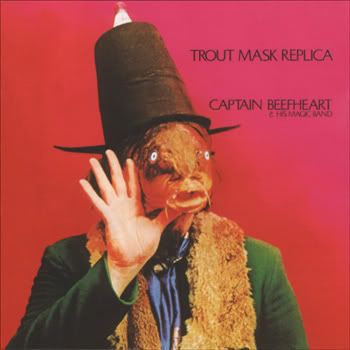
Captain Beefheart and his Magic Band, TROUT MASK REPLICA


Straight/Reprise, 1969; available

28 tracks, 79:08

I'm pretty sure most of you know this one by now, so I won't be describing it too much. If you haven't, you probably should. It truly is as wild and wonderful as everybody says it is. When it was released forty years ago, it seemed there really wasn't anything quite like this in rock. Maybe some contemporary bands were much freakier with less recognition (the Red Krayola and Cromagnon come to mind), but TROUT MASK REPLICA still sounded not quite like anything else. Twenty-eight tracks were spread over two LPs (now on one CD), a good chunk of which are under three minutes; of these, three tracks are a capella, one ("The Blimp (mousetrapreplica)") has phoned-in vocals with music by the Mothers of Invention, and three are instrumentals. If you're familiar with the story behind the recording, I won't bore you; if not, you may want to read up on just how much of a control freak the Captain really was, and you should keep in mind supposedly none of this album is improvised. The real question is whether any of it still holds up. I truly think so; when I first heard it ten years ago, I wasn't quite ready to fathom what was going on here. Needless to say, that position has since changed. Noise-rock, no wave, the New York downtown scene, punk, post-punk... this album could fit into ANY of those categories, but it obivously predates them all by a long shot. An essential slice of avant-rock history!

Sunday, August 23, 2009

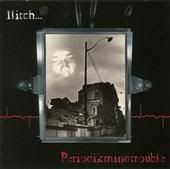
Ilitch, PERIODIKMINDTROUBLE


Oxygene, 1978; reissued and expanded to two discs by Fractal; available

Fractal edition: 2 discs. Disc 1: 7 tracks, 71:06. Disc 2: 12 tracks, 75:38

More French insanity! Ilitch was essentially multi-instrumentalist Thierry Müller. On their next album, 10 SUICIDES, there was a full band, but for the majority of PERIODIKMINDTROUBLE it's just Thierry and his arsenal of instruments. On two tracks he's assisted by his brother Patrick, and there is a rerecorded track with Laurent Saïet on guitar, but those are the only exceptions. The material was recorded between 1974 and 1978. The original LP consisted of a few of the "Innerfilmsequences" on side A, while the B-side was entirely occupied by "Periodikmindtrouble". For the reissue, "Periodikmindtrouble" itself is track 1 of disc 1, with tracks 2 to 4 being "Ballades Urbaines", followed by the two-part "A.B.ss" and the short "Micik Für Brokenpedalboard". Disc 2 is the entirety of the "Innerfilmsequences", including the five released on the original LP and two which were released on the severely rare P.T.M. WORKS cassette. As for the music itself, Ilitch comes across as the evil offspring of Terry Riley, NO PUSSYFOOTING and early industrial. At times this veers close to Heldon, particularly on "Periodikmindtrouble" itself, which is performed on organ and "destructed" guitar. That being said, Ilitch is still a uniquely creative entity. Disembodied voices are scatterred throughout "Ballades Urbaines", which is equally covered in distortion and effects, making for a truly unsettling mix. This was originally intended to be the B-side of the LP, and it would have been a fine release on its own. The remaining compositions on disc 1 are early recordings, both from 1974, and these are every bit as interesting as the rest of the material. Disc 2 goes into progressively more abstract territory. Harmonium, guitar, organ, synths..... all find their way into Müller's hands. It's interesting to note that Müller used a Revox A77 recorder, the same model Eno used for NO PUSSYFOOTING. Ilitch's material is similarly displaced in time, being shrouded in echo, reverb, delay, and all manner of modifications that combine to form an entirely mesmerizing and disorienting collection. It comes across in the end as a truly amazing cross between cosmic music, early industrial, musique concrete, and proto-dark ambient. Needless to say, this is highly recommended. Ilitch continues to release albums; the latest offerrings are more synth-pop, but still very worth a listen. Also worth hearing is their second album, 1980's 10 SUICIDES, which is like a demented outsider take on synth-pop.
Friday, August 14, 2009

Jean Guérin, TACET


Futura, 1971; reissued by Elica; availability uncertain

8 tracks, 39:11

The French never cease to amaze and confound! Jean Guérin was mostly known as a drummer, appearing on quite a few free jazz sessions. For this, his only solo outing, he set out to make a soundtrack to a film called BOF. Having never seen the film, I'm not certain how much of the album was actually used. The soundtrack was released as TACET on the legendary Futura label (also known for putting out records by Jacques Thollot, Red Noise, and Mahogany Brain). His choice of musicians is absolutely impeccable; notable figures of the French scene like Bernard Vitet and Philippe Maté contribute their talents. Vitet even plays "underwater trumpet"! Guérin himself takes up a lot of instruments, from electric bass to darbouka to VCS3 and sound generators. Overall, TACET is full of strange sounds and even stranger arrangements. Françoise Achard contributes wordless vocals to several tracks, and most of the time her voice sounds like another instrument rather than a human being. The use of both contrabass and electric bass on some tracks provides an interesting sound, considering the electric bass is treated to sound nothing like it should (this isn't a bad thing!). It's hard to pick out standout tracks, since this all flows together perfectly and is best experienced all the way through. The first and last tracks, "Triptik 2" and "Gaub 71" respectively, both feature the same fast rhythm (which sounds like a mix of darbouka and primitive drum machine), but otherwise are different entities. "Gaub 71" is the more experimental of the two, with a constantly evolving structure over its eight minutes. "Triptik 2" is punctuated with the trumpets of Jean Paul Rondepierre and Vitet, and Maté contrubutes his saxophone. This is the closest that TACET comes to jazz, as the remaining tracks are pure explorations of sound, somewhere between free jazz and the cosmic explorations of Kluster et al. Truly an obscure masterpiece, TACET deserves a much bigger audience; other reviewers have pointed out that this points forward to Herbie Hancock's space classics MWANDISHI and CROSSINGS, which isn't very far off. It definitely points forward to post-rock as well, with its use of studio effects and loose structures. HIGHLY recommended!

Sunday, August 2, 2009

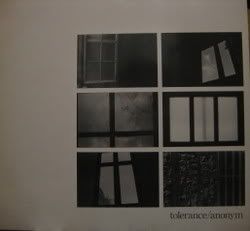
Tolerance, ANONYM


Vanity, 1980; out of print

9 tracks, 40:08

Tolerance were a mysterious Japanese duo consisting of Junko Tange on voice, synth, and piano and Masami Yoshikawa on guitar. There's a good chance both performed on other electronics too. For this, their first LP, Tolerance created an absolute masterpiece of minimal electronic atmospherics. The guitars alone cover a large variety of styles, ranging from gentle sliding to folky noodling to full-on skronk. The accompanying sounds also manage to cover quite a range, while all being decidedly experimental. Spoken female vocals (which seem to be in French!) mix in effortlessly with strange electronic rhythms and gentle Satie-esque piano, creating a unique sound. The electronics used truly aren't easy to identify, and may even be homemade. Each track is excellent, and they have some truly odd and interesting names. "I Wanna Be A Homicide", "Laughin In The Shadows", "Tecno-Room"..... really, the song titles alone should tell you this is great! This could even be considered Japan's krautrock album! Loose comparisons to such other visionaries as the Sperm and Moolah can be made, and this definitely holds a place as one of those truly unusual albums that every serious avant-gardist should hear. They went on to record another album, DIVIN, which is almost as good. Sadly, neither is available currently (there was a grey-area vinyl of DIVIN a few years back), and both are in sore need of a reissue.

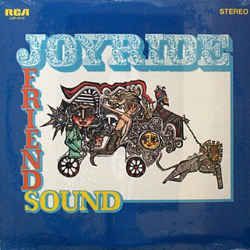
Friendsound, JOYRIDE


RCA Victor, 1969; reissued on grey-area vinyl a few times; availability uncertain

6 tracks, 34:43

It's hard to believe this was a Paul Revere & the Raiders side project. There's no real credits on the album, but yes indeed, this is Raiders members using the studio as an instrument. It sounds about as far removed from their main project as possible. What more can you expect, when "Brotherhood" is listed as producer?!?!?!? What few liner notes describe the recording of this album as "a musical free-for-all", which is as good a description as any! Beginning with the slow and druggy rock jam "Joyride", Friendsound soon leave any semblance of pop or rock behind. "Childhood's End" combines a mechanical rhythm (as in actual industrial machinery, not drum machine) and the chant "send me a dream" in a way that sounds a lot like what Cromagnon was doing; in fact, JOYRIDE as a whole has a lot of similarities to Cromagnon's only album (pop stars freaking out, chants and other non-traditional vocals, use of primitive sampling in doses). "Love Sketch" is an almost new agey instrumental, not too remarkable but not truly bad, and it goes right into "Childsong". This is a bizarre track made up of the sounds of a playground, chimes, flute or mellotron (it's hard to tell), and a LOT of tape manipulation. The kids' voices are subtly twisted, and the music grows louder while still exuding a calm beauty. This is a highlight of the album, and it ends side one on a great note. Side two consists of two tracks, and boy, are these weird! Both are about nine and a half minutes, and they're two different sides of the coin. "Lost Angel Proper St." has a bluesy organ, spoken effected vocals that get frequently eaten by the music, crazy electric guitar freakouts, and long stretches where the music changes completely, while still coming back to the original theme in a way. Last and definitely not least is "The Empire Of Light", which ends the album on its highest note; given the quality of the other tracks, this is saying a lot! Piano is the main instrument here, surrounded by all manner of sound effects. Everything from spooky organ to weird synthy squelches to unidentifiable tape manipulations comes into play, all with the meandering yet quite beautiful piano underneath. It's a truly amazing track, sounding remarkably like Moolah or Kluster. Far overdue for a reissue, JOYRIDE was a bold album that still sounds remarkably innovative. It's a shame they never recorded another album as Friendsound; they sure did continue on as the Raiders, but that's a little outside the scope of this blog. Perhaps that is for the best; this sort of thing is hard to capture twice. Consider this album a part of the 60s freakout holy trinity along with Cromagnon's CAVE ROCK/ORGASM and the Red Krayola's PARABLE OF ARABLE LAND, and until there's a proper CD reissue, try to hear it any way you can.

Monday, May 18, 2009

Negativland, NEGATIVLAND

Each cover is handmade and unique, so a picture would be useless*

Seeland, 1980; out of print**, but a mass-produced version is supposedly on the way

20 untitled tracks, 36:47

Nowadays known for their masterful satire of mass media and pop culture, Negativland began as a much different prospect. For their debut album, Negativland was Mark Hosler, Richard Lyons (both of whom were 17 when this was recorded!), and David Wills; the liners inform you that "occasionally you will hear the talents of" Peter Dayton, W. Kennedy M., and Joan. The instruments range from synths, organs, viola, guitars, tape loops, and the mysterious "Booper". While definitely primitive compared to their later work, the debut album is quite incredible on its own merits. A majority of the tracks are bizarre sound collages, featuring everything from household appliances and electronic birdcalls to the ambient sounds of televisions and radios. A few tracks do break from the "norm": a mournful acoustic guitar ditty here, a relatively traditional new wave tune there, and then there's one track with jittery rhythms and blips accompanying such random observations as "Play.... Black Sabbath....at seventy.... eight!". The sound collages, however, are the main draw, sounding like the bastard offspring of LUMPY GRAVY, THE FAUST TAPES, and early industrial a la Cabaret Voltaire or Nurse With Wound. It's not really musical by any stretch, but then does it need to be? Most fans tend to sell this album short; admittedly, it's an acquired taste, but give it a chance and it should grow on you. Their next two albums, POINTS and A BIG 10-8 PLACE, follow along a similar path, with fourth album ESCAPE FROM NOISE being considered the beginning of the satirical sound that Negativland is known for. I personally prefer the early work, since it's much less preachy and more about the genuine joy of having a twisted musical vision and the equipment to express said vision (but you should still hear their other albums if you haven't already; they truly are impressive). Negativland themselves are promising a reissue of the debut; while it won't have the unique covers, the "music" within still justifies the purchase.

*The packaging for this is truly great. The box itself is a thick cardboard box, like old reel-to-reel tapes came in. My copy's cover is a black and white photo of a guy brushing his teeth, pasted over a square of black construction paper. On the back is a piece of wallpaper, under which is a red sticker with the band's name, the catalog number,copyright information, and a hand-written "serial number" identifying which copy is yours (mine happens to be #1622). Inside, along with the CD, there are four inserts and a pin. One is simply a recipe for a coffee torte, another is a transcription of a bizarre food-oriented dialogue. The others have the credits for the album and a modified picture of a guy in pajamas whose arms reach nearly to the ground. Much like the album itself, the package is random but intriguing.

**Apparently limited to 9500 LPs and 4500 CDs

Monday, May 11, 2009

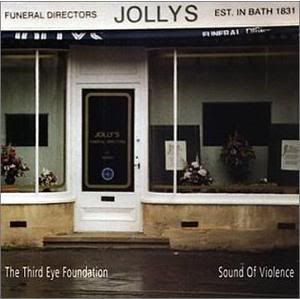
Third Eye Foundation, SOUND OF VIOLENCE


Domino/Merge, 1997; out of print, but two tracks are available on COLLECTED WORKS

4 tracks, 23:52

Following the extremely disturbing GHOST (reviewed previously here), Matt Elliott went further into the recesses of twisted electronics. SOUND OF VIOLENCE is perhaps the best non-LP 3EF release. Three of the tracks are over seven minutes long; the under-three-minute "Pain (Violence Version)" is the only track that feels like filler, but it's interesting filler nonetheless. The first two tracks, "Sound Of Violence" and "A Name For My Pain", are excellent progressions from GHOST. Frantic drum'n'bass beats are cloaked in whirlwinds of noise, from what sounds like the shrieks of the damned to jazzy bass and guitar accents. The sound is much cleaner than on GHOST; however, it takes a few listens to notice, so dense are the compositions. Little of Matt's SEMTEX-era sound remains (save for the amazing beats), and at times this sounds like what Stockhausen or Xenakis may have come up wuth had they dabbled in drum'n'bass. The final track is "Corpses (Version)". This is a skeletal remix of "Corpses As Bedmates", retaining the original's structure while massively reducing the noise and shaving off two minutes. It's much more effective than it should be, and its inclusion alone justifies this EP. Luckily, "Sound Of Violence" and "A Name For My Pain" are both well worth the price as well. This is an excellent transitional release, bidding farewell to 3EF's horrific and noisy early years while pointing forward to the less-frantic-but-still-jarring atmosphere of YOU GUYS KILL ME and LITTLE LOST SOUL. Unfortunately, this has gone out of print. "Sound Of Violence" and "A Name For My Pain" are included on disc one of COLLECTED WORKS along with GHOST and two tracks off the "Semtex" single, but you really should find the standalone release so you can hear "Corpses (Version)". A good used copy should be fairly inexpensive and easy to find.