Saturday, November 14, 2009

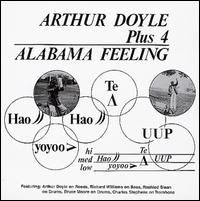
Arthur Doyle Plus 4, ALABAMA FEELING


AK-BA, 1978; reissued many times; out of print on CD, available on vinyl from Rank And File

6 tracks, 37:52

Oh MAN, is this some intense jazz! Let's cover the "Plus Four" first. Arthur Doyle's brave sidemen for this outing are drummer Bruce Moore, electric bassist Richard Williams, trombonist Charles Stephens, and drummer Rashied Sinan. All of these players truly shine on their instruments, with percussionists Sinan and Moore doing especially well supplying inventive fills and improvisations. Stephens and Williams also shine on their instruments, with interesting non-linear basslines and surprisingly interesting horn support. Doyle, however, is the true demonic genius of this quintet! Credited as playing "tenor voice-o-phone, bass voice-o-net", and flute, his playing is truly not quite like anything else. The "voice-o" terminology refers to his style of speak-playing, using the tenor sax and the bass clarinet in an almost hindewhu* way. Knowing this makes you wonder just what the hell he's saying, because his playing is always at full blast, with the skronk-o-meter (to coin a term myself; I think?) at eleven. This particular set was recorded in 1977 at the Brook in New York. Being the height of the no wave period, this had to go over well with that scene; in fact, Rudolph Grey of Red Transistor was at this show and was impressed enough to recruit Doyle for the Blue Humans**. While there are titles and rough cuts at the end of each track, this is really best experienced the way it was recorded: all in one go at maximum volume. "November 8th or 9th - I Can't Remember When" opens the set with a particularly scorching performance by Doyle, and the supporting quartet surprisingly manage to match his energy. Other highlights include the multi-part "Development", which almost approaches AMM territory with its flute run and raging percussion, as well as the mostly solo sax piece "Something For Caserlo, Larry & Irma". The latter piece isn't exactly restrained, but compared to the other tracks it comes across as a bizarre moment of tranqulity. The recording isn't as great as it could have been, but it could have been a LOT worse. Good luck finding this, but free jazz fans can't say they know the genre until they do. Fans of free improv and no wave will find some common ground here; others might want to approach this with caution, but as with most albums reviewed here, it'll be worth the effort. Other Doyle albums are out there; some find him experimenting with his "Electro-Acoustic Ensemble", and some are very raw home recordings that border on outsider music. All of it is worth investigating. Harder to find but easily ALABAMA FEELING's equals are Noah Howard's THE BLACK ARK and Milford Graves' BABI MUSIC, which find Doyle laying down incredible performances as a sideman himself.*** Check the comments for a great link to an interview with Doyle (thanks, Roy!).
*From Wikipedia (credit totally being given!): "Hindewhu is a style of singing/whistle-playing of the BaBenzélé pygmies of the Central African Republic. The word is an onomatopoeia for the sound of a performer alternately singing pitched syllables and blowing into a single-pitch papaya-stem whistle." Which is a better definition than I could ever give! http://en.wikipedia.org/wiki/Hindewhu

**The excellent (and unfortunately VERY rare) LIVE 1980 documents the trio of Doyle, Grey, and the incredible free jazz drummer Beaver Harris. Very much worth checking out, and good luck!

***ALSO worth investigating is Charles Tyler, founder of AK-BA. His albums for ESP-Disk' (CHARLES TYLER ENSEMBLE and EASTERN MAN ALONE) find him in ferocious and psychedelic modes, respectively.

Thursday, November 5, 2009

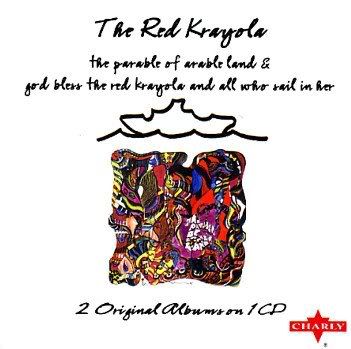
The Red Krayola, THE PARABLE OF ARABLE LAND, GOD BLESS THE RED KRAYOLA AND ALL WHO SAIL WITH IT, COCONUT HOTEL, and LIVE 1967


Originally released on International Artists in 1967 and 1968 respectively; PARABLE had 13 tracks, GOD BLESS had 20. My copy is a Charly reissue, which omits one of the "Free Form Freak-Out" tracks for a total of 32 tracks, 77:10


Drag City, 1995; available

44 tracks, 33:23


Drag City, 1998; available

2 discs. Disc 1: 3 tracks, 43:56. Disc 2: 3 tracks, 64:50.

Texas was quite a strange place back in the Sixties. No band proved this point more than Houston's infamous Red Krayola. At this point consisting of Mayo Thompson, Rick Barthelme, and Steve Cunningham, the Red Krayola (Crayola on the first album before being changed for legal reasons) concocted a strange mix of current psychedelia and ahead-of-its-time experimentation. This mix is most rooted in psychedelia on THE PARABLE OF ARABLE LAND. Tracks like "Hurricane Fighter Plane", "Pink Stainless Tail", and "Former Reflections Enduring Doubt" could get radio play then and now, even if the musicianship is sometimes a little clumsy and Thompson's words are abstract at best. However, the "Free Form Freak-Out" tracks between the songs push this into stranger territory. These are full-on slabs of cacophony featuring the "Familiar Ugly", an assortment of friends of the band including Roky Erickson from 13th Floor Elevators* on organ. Featuring everything from feedback to blown bottles to matchsticks rubbed together, these tracks are actually fascinating experiments which creatively flow into the proper songs; they are also the only recorded appearance of the Familiar Ugly. There is also the instrumental title track, which is built around what appears to be a percussive loop and is completely devoid of structure otherwise; this track almost seems like a blueprint for COCONUT HOTEL. As a whole, THE PARABLE OF ARABLE LAND is still a solid listen; it's also part of my personal Holy Trinity of Sixties Freak-Out Albums, along with Friendsound's JOYRIDE and Cromagnon's ORGASM/CAVE ROCK. The compilation EPITAPH FOR A LEGEND has some far more restrained (and folky!) demo versions of tracks from this album along with several other treasures of Texas-style rock and psych.

THE PARABLE OF ARABLE LAND was the Red Krayola's true freak-out album, but it did have identifiable ties to rock. COCONUT HOTEL was a complete rejection of rock norms, venturing further into free improvisation. This gem of an album was recorded in 1967, but International Artists rejected it for being too strange. Nothing on here is nearly as noisy as the "Free Form Freak-Out" tracks , but they aren't very musical either! With simplistic titles such as "Organ Buildup", "Free Guitar", and "Piano", most tracks deliver improvisations performed on the track's title instrument, though "Vocal" features some interesting effects and ambiance alongside "headphone vocals" by Frank Davis. The more abstractly named "One-Minute Imposition", "Boards", and "Water Pour" have more varied instrumentation but are no less adventurous in their search for pure sound. Then there are the "One-Second Pieces". Yes, these are exactly what you'd expect them to be: one-second bursts of noise, mostly performed on some sort of horn, piano, and drums. Some of the tracks feature more than one of these pieces, while most are just the blast of sound and then a few seconds of silence. Believe it or not, these are pretty entertaining, and they almost form a micro-suite after a few listens. More adventurous listeners (and fans of free improv in general) should find plenty to like on this disc.

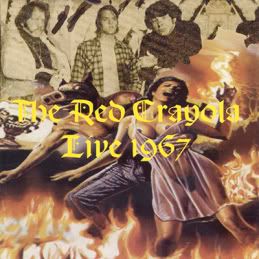
LIVE 1967 is more intimidating. At two discs, these noisefests can be difficult to take in one sitting; it's best to tackle it one disc at a time. Disc one features their performance at the Angry Arts Festival on June 29, as well as two acoustics-and-voice recordings made in the band's hotel room that evening. Disc two finds them performing (believe it or not) at the Berkeley Folk Music Festival, July 2 through July 4. The first disc has its moments, mostly during the live show. The hotel recordings can be a little annoying when the vocals get carried away; while interesting the first time around, these attempts at abstract chanting overstay their welcome quick. These minor flaws are completely made up for with the second disc. Not only are the three performances excellent, but one has a guest performance by John Fahey**! The July 4 concert is especially amusing since it was from a radio broadcast. The announcer talks for quite a bit over the band, assuming they're warming/tuning up! All of the performances (except the hotel recordings) feature heavy use of feedback, one-second pieces, drones, improvisation, and other avant-garde elements. It was a bold move to perform such avant-garde material for festival crowds. The audiences, however, seem to love it, and the applause at the end of each performance is surprisingly quite enthusiastic. The recording quality is amazingly good consdering the age and circumstances of the recordings. One or two tracks have bits of audience chatter during the performance, but it doesn't interfere too much with the music. This is definitely an acquired taste, but fans of this sort of thing will absolutely love it.

After the preceding albums, Rick Barthelme left the band. Tommy Smith replaced him for GOD BLESS THE RED KRAYOLA AND ALL WHO SAIL WITH IT. Thompson and company come across as much more restrained here, but it's still as quirky as ever. None of the tracks are over three minutes, and eleven of them are less than two minutes. Most of these tracks have strange structures and rhythms, sounding very much like a product of the post-punk years rather than the psychedelic years. Strangely enough, one of the tracks is even called "Coconut Hotel"! Echoes of that album show up on two tracks: the self-explanatory "Free Piece", and "Listen To This", which is a one-second piece with an introduction. Another intriguing oddity is the EXTREMELY lo-fi "The Shirt", which has Thompson's voice and guitar accompanied by a Ferrari-esque "slice of life" recording. It's a solid album and a great listen, but it's also the least adventurous effort from this period. Then again, the least adventurous Krayola outings still make most other bands look tame and reserved! Fans of Beefheart, Zappa, et al may want to begin investigating Thompson's world here.

Mayo Thompson has kept the Red Krayola going over the years, working with everyone from Pere Ubu, the Rough Trade Roster, and several members of Chicago's post-rock elite. All of his work is worth checking out, but these four albums represent the genesis (some would say the apex as well) of his twisted musical vision. Start with THE PARABLE... and GOD BLESS... and go from there.

*The 13th Floor Elevators were the Red Krayola's only real competition; truth be told, while they are a great band, they're not really as out there as reviews would make you think.

**There is a legendary lost studio album recorded around this time featuring Fahey and the Red Krayola. Lelan Rogers (head of International Artists and Kenny Rogers' brother) refused to hand over the tapes, and their location and state of preservation are unknown. If this ever gets located and issued, you'll certainly find a review of it here!

Friday, October 30, 2009

This Heat, THIS HEAT


Piano, 1979; reissued most recently by This Is; available

11 tracks, 48:30

This Heat are one of those groups who only got the recognition they deserved after they split up. Consisting of Gareth Williams, Charles Bullen, and Charles Heyward, This Heat were something of an enigma. Bullen and Heyward used to perform improvisations as Dolphin Logic, and that particular art form certainly carried over to This Heat. Their debut album is a mix of live and studio recordings; it's almost impossible to tell which are which (not a bad thing at all!). Bookended by the short droning "Testcard" pieces, the music covers a LOT of ground. Elements of dub, prog rock, krautrock, post-punk, and free improv all combine to form one of the more varied early industrial albums. Standout tracks like "Twilight Furniture", with its insistent drumming and minimal guitar coloration, and th brutal prog-punk stormer "Horizontal Hold" almost sound like different bands. Most tracks ebb and flow right into each other, providing a fascinating listen when played the whole way through. My personal favorites are the eerily atmospheric "The Fall Of Saigon" and the absolutely incredible "24 Track Loop", which takes a short drum loop and turns it into something that for all the world sounds like twisted IDM/drum'n'bass, YEARS before IDM or drum'n'bass even existed! The whole album is impressive, and it is the best This Heat album. This Heat would release one more album during their lifetime, the equally impressive DECEIT, which does lean more towards songs than atmospheres,as well as the more abstract HEALTH AND EFFICIENCY EP. The archival releases MADE AVILABLE (John Peel sessions, including alternate versions of tracks from THIS HEAT and DECEIT), REPEAT (basically an extended take on "24 Track Loop" and two more abstract pieces), and LIVE 80/81 are also worth checking out, as are the post-This Heat projects Camberwell Now (Heyward and later member Trefor Goronwy) and Flaming Tunes (Williams).

Sunday, October 18, 2009

Luc Ferrari, PRESQUE RIEN


INA-GRM, 1995; available

4 compositions spread over 10 tracks (see review), 77:13

The late Luc Ferrari had a gift for truly innovative recordings. While he definitely stuck to musique concrete, there's no mistaking a Ferrari piece for anyone else. This CD is a compilation drawn from four separate releases and covering three decades. "Music Promenade" and "Presque rien no. 1, le lever du jour au bord de la mar" date from the late '60s, "Presque Rien No. 2, ainsi continue la nuit dans ma tête multiple" is from '77, and "Presque rien avec filles" is the most recent, being completed in '89. Actually, the above dates for all pieces should say "completed in (year)"; each one apparently took quite a while to finish. However, the effort was worth it! "Music Promenade" is perhaps the most primitively conceived; essentially consisting of four tapes playing simultaneously, it is a densely loaded sonic collage of epic proportions. Prerecorded music, laughter, discussions, animal sounds.... yeah, everything shows up here, possibly even the kitchen sink! "Presque rien no. 1", by comparison, seems deceptively simple. It is, as the title makes clear, a recording of "dawn at the seaside" in a Yugoslavian village with VERY subtle manipulation. While basically a field recording, this is an intensely fascinating listen. Motorboats depart from the shore, the echoing of the motors creating electronic detritus in their wake (excuse the pun). People sing what seems to be a traditional song. Cicadas buzz and hum, providing their own form of music. At this point, the listener is probably wondering which sounds are left raw and which are processed and/or added to the mix. After twenty minutes, the tape abruptly cuts off, and the piece is over. But up to that point, you have been transported to the village, and the result of coming back is jarring. Incredible as "no. 1" is, it pales in comparison to "Presque rien no. 2". Subtitled "thus the night continues in my multiple head", Ferrari initially considered this too personal to release; thankfully he changed his mind! The recording itself is much more active on Ferrari's part. He actually carries the microphone and tape recorder, so his footsteps and softly spoken words are part of the natural soundscape. The sounds of birds, insects, and other animals dominate the piece, but these are often electronically manipulated and layered onto the initial recording. In addition, Ferrari seamlessly grafts such musical elements as organ drones and what could very well be electronic percussion onto the recording. For its entire 21:29 duration, "no. 2" is completely fascinating and not really like anything else being done at the time. "Presque rien avec filles" closes the disc, and it is a decent piece. However, the circa '89 production and electronic sounds haven't dated nearly as well as the preceding pieces. That minor quibble aside, "avec filles" is still a delightful listen, if far removed from the other two "Presque rien" pieces. The noisiest of the series, it begins with sheets of white noise and goes on to incorporate random electronic drums and other interesing touches, all surrounded by the sound of girls talking to each other. It's worth noting that the CD indexing divides all the compositions into multiple tracks. Thus, "Music Promenade" occupies tracks 1 and 2, "Presque rien no. 1" is on 3 through 5, "no. 2" is 6 to 8, and "avec filles" fills up 9 and 10. Any serious fan of electronic music, musique concrete, or modern composition needs these pieces, and this is the best place to get them all at once. Alternately, once you're hooked on Ferrari, you may want to purchase the 10-disc box set; it's reasonably priced (usually about $100, which is VERY low for a multi-disc set) and contains all the essential compositions. The compilation SON MEMORISE has "Presque rien no. 4", which is very much worth hearing as well; it also has a piece from the same period as "no. 2" and the incredible "Salicebury Cocktail", which was one of Ferrari's last works.

John Cage, VARIATIONS IV


Legcay, 2001; available

7 tracks, 65:29

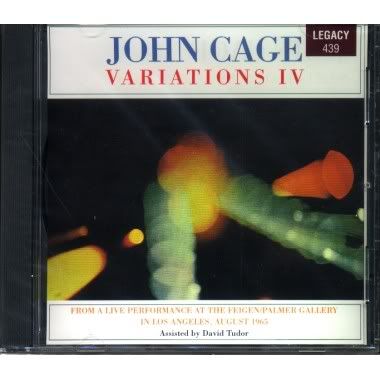
It's strange that John Cage recordings exist, considering his disdain for recordings in general. Yet here it is, two volumes of a recording of one epic performance, edited down into just over sixty-five minutes and combined on this CD. Assisted by David Tudor, Cage set up a very complex audio system in the Feigen/Palmer Gallery in Los Angeles. I'm not exactly certain on what was done here, but records and sounds picked up by ambient microphones do come into play, as do radio broadcasts. In the end, the result truly is better heard than described, sounding like where musique concrete, plunderphonics, and chance composition combine. If this review seems rather short and not overly descriptive, it's because this truly is a difficult experience to capture in words. Go find it and hear it and you'll understand.

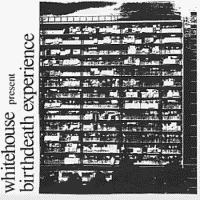
Whitehouse, BIRTHDEATH EXPERIENCE


Come Organisation, 1980; reissued by Susan Lawly; available, but tends to go in and out of print

6 tracks, 32:49

With this short album, Whitehouse were introduced to the world. At this stage, Whitehouse was William Bennett, Peter McKay, and Paul Reuter (this would be the lineup for TOTAL SEX and BUCHENWALD as well). Nowhere near as abrasive as the Bennett-Best-Sotos years, this may be the only Whitehouse album that could be called "charming" without any sense of irony. The comparitively minimal nature of this album is reflected by the equipment used: two EDP Wasp synths (legendary for their unique sound and mercurial nature, and one of which was modified by Throbbing Gristle's Chris Carter), a tone generator, and an Electro-Harmonix Memory Man. "On Top" begins with some low feedback and squiggling synth noises, soon joined by Bennett's heavily reverbed vocals. His delivery is far less intense than it would later be, and he actually sounds slightly meek at times! The music, however, is anything but tame, constantly and subtly mutating over the six minute duration. Oddly enough, four out of the six tracks are just over six minutes; whether this was intentional isn't certain. "Mindphaser" has Bennet's vocals much lower in the mix, buried under a fuzz-and-feedback drone. On this track, that works to his benefit. He keeps intoning for the listener to "relax/elax/listen to the master/you like that/FEEL THE PAIN/and pleasure" etc. etc., and the effect is DEFINITELY not as unsettling now as it may have been twenty-nine years ago, but it's still an interesting (if flawed) track. "Rock and Roll" closes side one with some random yet strangely musical explorations, held together by the tone generator's steady pulse. Over this, Bennett delivers the album's most intense vocal performance, screaming his anger at the fallacy of rock for all to hear. Side two features another three songs in a similar vein. "The Second Coming" sounds like the best parts of side one combined, while "Coitus" is the noisiest track on the album. Then there's the title track, which closes the album and is the shortest track at three and a half minutes. It's also completely silent, not even containing the sound of tape hiss or vinyl playing. Whether this is a waste of space or a stroke of genius is up to the listener, but after playing this album it's certainly not unwelcome! As stated above (and as most of you probably know already), Whitehouse would go on to become one of the harshest groups in electronic music, coining the term "power electronics" and delivering such endurance tests as ERECTOR and MUMMY AND DADDY. BIRTHDEATH EXPERIENCE is a crucial look at their early years, even if it is rather tame by their later standards. It's also worth hearing to see how Whitehouse were influential in their own way on later strains of industrial and noise music.

Thursday, October 15, 2009

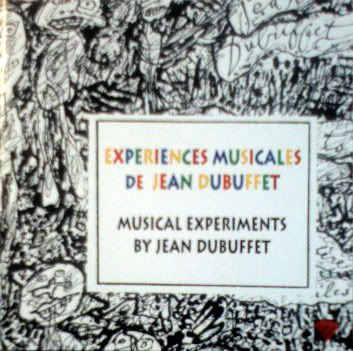
Jean Dubuffet, EXPÉRIENCES MUSICALES


Mandala, 1996 (see review); availability uncertain

9 tracks, 75:19

While mostly known as a visual artist and coiner of the term "art brut", Jean Dubuffet made some very strange recordings as well. This compilation is something of a "best of"; the original EXPÉRIENCES MUSICALES was a box set of six ten-inch records, and these nine tracks represent the cream of the crop. In the liner notes (reproduced in French, English, and German), Dubuffet admits his lack of experience with the instruments used and requests that musicians keep this in mind while listening. Regardless of his skill, Dubuffet creates dense masses of sound with a true arsenal of instruments(which range from flute, cello, and xylophone to more exotic instruments like cymbalon, "paper trumpet", and Chinese mouth organ). All recordings date from 1961, and while the sound quality definitely reflects this, it wouldn't sound right remastered. "La Fleur De Barbe" opens the disc with nearly twenty-four minutes of musical chaos and strangely intoned poetry. It's the only track to feature vocals, and it is quite a stunner, never locking into repetition once. The seven minute "Coq Á L'Oeil", by contrast, is a solo piano improvisation. Some tracks use only a few instruments while others simply say "diverse instruments" and leave it to the listener to decide what is being played. All of the tracks were achieved by multitracking and editing different improvisations; Dubuffet claimed to be ignorant at the time of musique concrete et al, but he came up with his own (intentionally) primitive version. Overall, it's a prime slice of free improvisation, residing somewhere between AMM and outsider music. Fans of Dubuffet's art, musique concrete, and free improvisation would be very much impressed with this effort; his MUSIQUE BRUT is also worth hunting down, though it is far more difficult to find. Good luck!

Edit: On the easier-to-find front, Dubuffet did the cover art for Jasun Martz' THE PILLORY, which is an amazing avant-prog/neo-orchestral masterpiece. Get this as well!

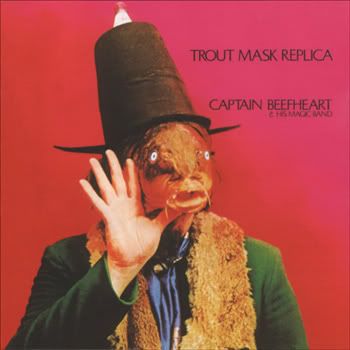
Captain Beefheart and his Magic Band, TROUT MASK REPLICA


Straight/Reprise, 1969; available

28 tracks, 79:08

I'm pretty sure most of you know this one by now, so I won't be describing it too much. If you haven't, you probably should. It truly is as wild and wonderful as everybody says it is. When it was released forty years ago, it seemed there really wasn't anything quite like this in rock. Maybe some contemporary bands were much freakier with less recognition (the Red Krayola and Cromagnon come to mind), but TROUT MASK REPLICA still sounded not quite like anything else. Twenty-eight tracks were spread over two LPs (now on one CD), a good chunk of which are under three minutes; of these, three tracks are a capella, one ("The Blimp (mousetrapreplica)") has phoned-in vocals with music by the Mothers of Invention, and three are instrumentals. If you're familiar with the story behind the recording, I won't bore you; if not, you may want to read up on just how much of a control freak the Captain really was, and you should keep in mind supposedly none of this album is improvised. The real question is whether any of it still holds up. I truly think so; when I first heard it ten years ago, I wasn't quite ready to fathom what was going on here. Needless to say, that position has since changed. Noise-rock, no wave, the New York downtown scene, punk, post-punk... this album could fit into ANY of those categories, but it obivously predates them all by a long shot. An essential slice of avant-rock history!

Sunday, August 23, 2009

Ilitch, PERIODIKMINDTROUBLE


Oxygene, 1978; reissued and expanded to two discs by Fractal; available

Fractal edition: 2 discs. Disc 1: 7 tracks, 71:06. Disc 2: 12 tracks, 75:38

More French insanity! Ilitch was essentially multi-instrumentalist Thierry Müller. On their next album, 10 SUICIDES, there was a full band, but for the majority of PERIODIKMINDTROUBLE it's just Thierry and his arsenal of instruments. On two tracks he's assisted by his brother Patrick, and there is a rerecorded track with Laurent Saïet on guitar, but those are the only exceptions. The material was recorded between 1974 and 1978. The original LP consisted of a few of the "Innerfilmsequences" on side A, while the B-side was entirely occupied by "Periodikmindtrouble". For the reissue, "Periodikmindtrouble" itself is track 1 of disc 1, with tracks 2 to 4 being "Ballades Urbaines", followed by the two-part "A.B.ss" and the short "Micik Für Brokenpedalboard". Disc 2 is the entirety of the "Innerfilmsequences", including the five released on the original LP and two which were released on the severely rare P.T.M. WORKS cassette. As for the music itself, Ilitch comes across as the evil offspring of Terry Riley, NO PUSSYFOOTING and early industrial. At times this veers close to Heldon, particularly on "Periodikmindtrouble" itself, which is performed on organ and "destructed" guitar. That being said, Ilitch is still a uniquely creative entity. Disembodied voices are scatterred throughout "Ballades Urbaines", which is equally covered in distortion and effects, making for a truly unsettling mix. This was originally intended to be the B-side of the LP, and it would have been a fine release on its own. The remaining compositions on disc 1 are early recordings, both from 1974, and these are every bit as interesting as the rest of the material. Disc 2 goes into progressively more abstract territory. Harmonium, guitar, organ, synths..... all find their way into Müller's hands. It's interesting to note that Müller used a Revox A77 recorder, the same model Eno used for NO PUSSYFOOTING. Ilitch's material is similarly displaced in time, being shrouded in echo, reverb, delay, and all manner of modifications that combine to form an entirely mesmerizing and disorienting collection. It comes across in the end as a truly amazing cross between cosmic music, early industrial, musique concrete, and proto-dark ambient. Needless to say, this is highly recommended. Ilitch continues to release albums; the latest offerrings are more synth-pop, but still very worth a listen. Also worth hearing is their second album, 1980's 10 SUICIDES, which is like a demented outsider take on synth-pop.

Friday, August 14, 2009

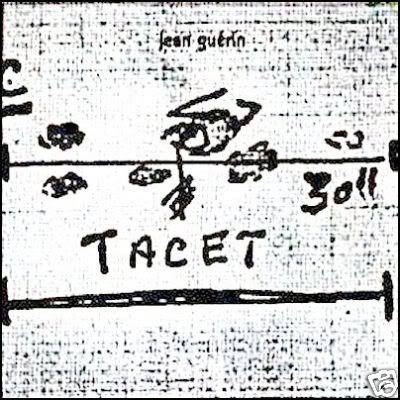
Jean Guérin, TACET


Futura, 1971; reissued by Elica; availability uncertain

8 tracks, 39:11

The French never cease to amaze and confound! Jean Guérin was mostly known as a drummer, appearing on quite a few free jazz sessions. For this, his only solo outing, he set out to make a soundtrack to a film called BOF. Having never seen the film, I'm not certain how much of the album was actually used. The soundtrack was released as TACET on the legendary Futura label (also known for putting out records by Jacques Thollot, Red Noise, and Mahogany Brain). His choice of musicians is absolutely impeccable; notable figures of the French scene like Bernard Vitet and Philippe Maté contribute their talents. Vitet even plays "underwater trumpet"! Guérin himself takes up a lot of instruments, from electric bass to darbouka to VCS3 and sound generators. Overall, TACET is full of strange sounds and even stranger arrangements. Françoise Achard contributes wordless vocals to several tracks, and most of the time her voice sounds like another instrument rather than a human being. The use of both contrabass and electric bass on some tracks provides an interesting sound, considering the electric bass is treated to sound nothing like it should (this isn't a bad thing!). It's hard to pick out standout tracks, since this all flows together perfectly and is best experienced all the way through. The first and last tracks, "Triptik 2" and "Gaub 71" respectively, both feature the same fast rhythm (which sounds like a mix of darbouka and primitive drum machine), but otherwise are different entities. "Gaub 71" is the more experimental of the two, with a constantly evolving structure over its eight minutes. "Triptik 2" is punctuated with the trumpets of Jean Paul Rondepierre and Vitet, and Maté contrubutes his saxophone. This is the closest that TACET comes to jazz, as the remaining tracks are pure explorations of sound, somewhere between free jazz and the cosmic explorations of Kluster et al. Truly an obscure masterpiece, TACET deserves a much bigger audience; other reviewers have pointed out that this points forward to Herbie Hancock's space classics MWANDISHI and CROSSINGS, which isn't very far off. It definitely points forward to post-rock as well, with its use of studio effects and loose structures. HIGHLY recommended!