Wednesday, October 26, 2011

Pytolator, INLAND


Ata Tak, 1979; available with bonus tracks

CD: 18 tracks, 59:48

Kurt "Pyrolator" Dahlke began his career in Deutsch Amerikanische Freundschaft (specifically on PRODUKT DER...) and ended up dividing his time between his solo work and Der Plan. This, the second release on the Dahlke-founded Ata Tak (again, after PRODUKT DER...!), is his first solo venture. Unlike the later AUSLAND, this finds Pyrolator completely on his own. His arsenal of machines is quite impressive - an early Italian synth, an organ, a Korg MS20, two mics, and a tape setup. Interestingly, this completely instrumental album was intended as a protest piece against prevailing cultural views in Germany! The pieces themselves cover a lot of ground in a krautrock-influenced industrial way. The four "Inland" tracks, as well as "Minimal Tape 1/2.3", are surprisingly harsh masterpieces of early synth noise. On the opposite side of the spectrum, there are the dreamy ambient "Minimal Tape 1/8" and a couple of catchy synthpop numbers (my favorite of these is "Danger Cruising", which sounds remarkably like its name). "Bärenstrasse" and "Nordatlantik" round out the stylistic diversity with pioneering bits of dark ambience. The six bonus tracks are very worthwhile as well, with the droning "Die Einsamkeit Des Langstreckenläufers", "Struktur 01" and "Struktur 22" being particularly delightful. Most of these were recorded prior to INLAND, but soundwise they are along similar lines. While this is much more minimal (and nowhere near as lighthearted) than anything else Pyrolator ever did, it's a wonderful and enjoyable slice of eccentricity. It's also my favorite Pyrolator solo release, but nervous fans might want to start with AUSLAND or Der Plan's GERI REIG before going INLAND.

Tuesday, September 20, 2011

Hugh Le Caine, COMPOSITIONS DEMONSTRATIONS 1946-1974


JWD/EMF, 1999; available

38 tracks, 73:56

The late Hugh Le Caine is one of the forgotten pioneers of electronic and concrete music. This release collects every known recording of his work, as well as a few recordings by other musicians using his instruments. Among these self-made wonders are a touch-sensitive organ, two types of artificial larynx (ie, a primitive vocoder), custom-built multi-track recorders, and the Electronic Sackbut synthesizer. The latter is especially noteworthy since, being created circa 1946, it is the earliest known true synthesizer. The tracks presented include musique concrete classics like "Dripsody" (based on a drop of water that is turned into a metallic symphony, and which is present in mono and stereo forms) and "Study No. 1 For Player Piano And Tape"; strange "humorous sketches" like "This Thing Called Key" and "Sounds To Forget"; electronic experiments like "Ninety-Nine Generators" and "A Noisome Pestilence"; and short demonstrations of the instruments. The highlights (such as "Dripsody" and "The Burning Deck", which both appear twice in slightly different forms) are incredible. It's worth noting that Le Caine didn't compose a whole lot of pieces; he fully intended to have more skilled musicians compose works on his instruments. Thus, there are a lot of demonstrations on here. While these are included more for historical purposes than listenability, they're still fun in small doses, and the occasional commentary by Le Caine adds a lot of charm. Taken as a whole, this collection is an essential insight into an unfairly obscure genius and comes strongly recommended to all fans of electronic music, since many roots of more recent acts can be traced back to these experiments.

MORE ARCTIC HYSTERIA/SON OF ARCTIC HYSTERIA - THE LATER YEARS OF EARLY FINNISH AVANT-GARDE


Love Records, 2005; available

2 discs; disc 1 (MORE ARCTIC HYSTERIA):15 tracks, 76:07; disc 2 (SON OF ARCTIC HYSTERIA): 19 tracks, 73:48

Picking up where ARKTINEN HYSTERIA left off, this double-disc feast of experimental sounds covers 1970 to 1990 (with two bonus '60s tracks for good measure!). As the liner notes point out, the first disc leans more towards jazz and modern compositon, while the second is more on the rock side. Let's plunge into the track-by-track description, shall we?

MORE ARCTIC HYSTERIA

1.Pekka Streng, "Olen Väsynyt" ("I'm Tired", 1970) - A weird bit of prog-folk from this psychonaut. The main almost synth-like drone is actually produced by a Jew's harp. Nice opening track!

2.Karelia, "Kahella Sarvella" ("With Two Horns", 1972) - This is a somewhat grating rendition of a folk song. It's fairly close to the Godz or the Fugs. Free jazz guy Edward Vesala is involved, though!

3. Samsa Trio, "Kiven Poiminta" ("Pickin' Up A Rock", 1972) - It's our old friend Pekka Airaksinen! Here, he teams up with fellow ex-Sperm members Antero Helander and Mattijuhani Koponen to play free jazz. It's very different from the Sperm and Airaksinen's solo work, but it's very nice indeed!

4. The Omar Williams Experience, "Democracy" (circa 1971-1972)- Airaksinen and Helander team up with American poet Williams for a more chaotic form of free jazz. This is also a really good track. It ends with a brief but amusing recital from Williams.

5. Osmo Lindeman, "Ritual" (1972) - Early electronic bliss! Lindeman's concrete gem is intended to gently parody religious services. It rightfully won an award (in Italy!) the year it was composed. I highly recommend this for fans of Xenakis et al.

6. Jarmo Sermilä, "Electrocomposition 1" (1976) - Another unjustly little-known piece of early electronic wizardry! Performed solely on the EML 101, this squelchy delight deserves to be heard. Thank goodness for compilations like this!

7. Åke Andersson, "Kaukonen Ennen Vanhaan" ("Kaukonen In The Old Days", 1977) - This guy was one half of the Finnish equivalent of the BBC Radiophonic Workshop. The song is a shifting electronic landscape meant to evoke a Sami village. It accomplishes everything the Residents' ESKIMO meant to in just six minutes and fifty seconds. Amazing!

8. Gandhi-Freud, "A" (1975) - Airaksinen again, here performing solo under an alias. This short track is just over two minutes of weird and wonderful synth squiggles. It's not Airaksinen's most impressive work, but it's fun.

9. Jone Takamäki Trio, "Bhupala 1" (1982) - Normally a chaotic punk jazz outfit, Takamäki and company played a more ambient style of free jazz on their second album. This track, based on an Indian traditional theme, is taken from that album. It's a great example of Indian-themed jazz, with definite raga touches and a drifting dreamy atmosphere. Very nice indeed!

10. Lauri Nykopp, "Y - Part V" (1982) - Taken from a bizarre free improv ritual recording (!), this features Nykopp playing a didgeridoo near a haystack. There's quite a bit of silence incorporated into the piece as well. It's atmospheric, strange, and completely fascinating.

11. Edward Vesala, "Maailman Reuna" ("Edge Of The World", 1982) - A completely unexpected proggy excursion from Vesala and company. It's barely over two minutes, but it's a blast of fun that resembles early Soft Machine mixed with equally early Henry Cow. I really want to hear the rest of this album!

12. Matti and Pirjo Bergström, "Virkamiehet - excerpt from The Forgotten Horizon" ("Bureaucrats", 1980) - A husband and wife duo scoring an avant-garde dance production with catchy-yet-strange synthpop. It's great!

13. Ilkka Volanen, "Kahlaaja - excerpt" ("Wader", 1982) - Oh man, I wish they included this whole track! This is ten and a half minutes from a twenty-four minute piece. What IS here is an amazing and moody sound collage. This easily rivals anything Nurse With Wound was doing at the same time. Wonderful!

14. Kaj Chidenius, "W" (1964) - One of the two '60s bonus tracks, this is a Dadaist prankster reciting Schwitters' poem. In other words, it's the Finnish equivalent of "W" being said in various funny ways for just under a minute. Amusing but not essential.

15. M.A. Numminen, "Oigu-S" (1964) - This, on the other hand, is absolutely essential! It's a collage tape assembled by Numminen and Erkki Kurenniemi. Originally used to back up Numminen's performance on Kurenniemi's "voice machine", it stands on its own as yet another fascinating sound collage from Finland's early avant scene.

SON OF ARCTIC HYSTERIA

1. Kollaa Kestää, "Tähtien Rauha" ("Star Peace", 1978) - These guys were known as a punk band, but here they perform drum machine-led spacey new wave with moody vocals. It's a lot better than that sounds!

2. Aavikon Kone Ja Moottori, "Rakkaudella Sinulle" ("With Love To You", 1980) - Weird group chanting with electronic backing is cut off by the sound of a bird cage being beaten by a relay. Strange, but not bad.

3. Kari Peitsamo, "Puinen Koira" ("Wooden Dog", 1978) - The puckish Peitsamo was mostly known for quirky pop. This is the absolute opposite of quirky pop! For seven minutes, he produces some awful screeches from a violin. It's noisy, it's irritating, and it's amazing.

4. Yhtye, "Apatian Tanssi" ("Dance Of Apathy", 1979) - Yhtye's drummer pounds a bass drum in a rhythmic way for fifty-eight seconds. I love this minimalist joke more than I should.

5. The Silver, "Do You Wanna Dance" (1980) - Oh boy, HERE'S a monster! Three teens ("Harry Angel", "Calamity Jane", and an unknown third member; yes, that's ALL the info available!) destroy the classic rock tune and record the results to some kind of cheap tape recorder. This one has to be heard to be believed, but imagine the Shaggs as punks/noise-rockers and you'll have an idea. The shrieking breakdown is especially amusing. I genuinely love this song, even though it's truly untamed and unmusical.

6. Hefty Load, "Schrecklich" (1981) - Apparently put together to use up free studio time, Hefty Load plays a weird and loose style of space rock. The synth player was also the producer, and he had never played a synth before. Interesting track, really!

7. Vaaralliset Lelut, "Alkuasukkaiden Lääkkeet" (1984) - Would you believe this is catchy instrumental dub reggae performed by Finns? Would you believe it's also really good? Well, whether you believe it or not, both are true.

8. Jaakko Kangosjärvi, "Musiikki Ja Urheilu" ("Music And Sports", 1981) - Silly minimal synthpop with female vocals sung in German-accented Finnish. Utterly disposable (and those synths sound CHEAP!), but absolutely endearing. I find myself listening to this one a lot.

9. Tapa Paha Tapa, "I Love It" (1983) - This was some sort of collective band, but only two members play on this track. It's a nice and moody number, somewhat like Heldon. I'd love to hear more of this group.

10. Swissair, "Baggage Claim" (circa 1981) - Another collective, these guys seemed to be the heirs to the Sperm's throne. One of them plays a repetitive guitar line while two others play his pickups and pedals. There's also a primitive drum machine clunking along. It's utterly hypnotic and could easily be mistaken for solo Airaksinen (which is a VERY high compliment!).

11. Harri Tuominen, "Lippukunta" ("Brigade", 1984) - Interesting post-punk collage piece. It was inspired by Expressionist cinema, and it's fittingly moody and cinematic.

12. Suomen Poliisit, "Mihin Sie Meet Keijo" ("Where Yuh Goin', Keijo", 1984) - This is actually the cult act Sleepy Sleepers under a pseudonym. For this project, they played in a gloriously noisy and amateurish fashion to parody punk and noise-rock. "Hey Joe" gets this treatment here, and the results are wonderfully sloppy and nasty.

13. Kansanturvamusiikkikomissio, "Kalinka" (1985) - It's probably no surprise that this band is usually referred to as KTMK! This furious hardcore number features some truly frenzied vocals and delightfully angular guitar. It does seem somewhat out of place, but I personally love KTMK, so I don't mind!

14. Joan Bennett Museo, "Empty Faces" (1984) - This is strange minimal pop that degrades into weird vocalisations. The group was an offshoot of a performance art troupe called Homo $. Decent, but not a standout.

15. 500 Kg Lihaa, "Pallokentällä" (1982) - Finnish no wave is the best way to describe this stunner. Maritaa Kuula gets progressively crazier with her vocals, at one point uttering shrieks that would put Galas to shame. The band nobly keeps up with repetitive organ, dual guitars, and a steady rhythm. These guys had a long career, and I intend to acquire more of their stuff.

16. Super Ladex, "Olet Valloissasi" ("You're In Your Power", circa 1981-1984) - This is an acquired taste, that's for sure! Three siblings made this chaotic burst: two boys, nineteen and ten respectively, and a six-year-old girl. They went around their house grabbing random junk and objects. It sounds like most of the lyrics (which come from labels, comic books, and the like) are screamed or shouted by the girl, but some of it could very well be the boys. It also sounds like this is possibly a bunch of smaller songs assembled together noisecore-style, but there's no proof that this was the intent. While it's pretty funny and even creative, it didn't really need to run for eight minutes.

17. Gagarin-Kombinaatti, "Raskas" ("Heavy", 1984) - Early industrial from the Neubauten school. It's sadly short at only two minutes, but that doesn't change the fact that it's an amazing bit of grinding metallic synths and real sheet metal being pounded and drilled. Mika Vainio of Pan Sonic got his start here as well, and it's definitely interesting to hear what he was up to previously.

18. Jimi Tenor and his Shamans, "Le Petomane (380v)" (1990) - The most recent track on the collection is an interesting industrial piece by Tenor and his gang. There's some weird instrumentation, but the definite show stopper is the Sirkka II custom-built drum machine. I can't figure out how it works by looking at it, since it resembles a spinning wheel, but its thudding beats propel this nifty little tune. This one could honestly be mistaken for Test Dept.

19. Reinin Myrkky, "Snorkkelijenkka: ("Snorkel Jenka", 1989) - Closing out the collection is Tenor and some freinds parodying a jenka tune. It's an amusing blast of polka-esque silliness, and it's over in twenty-five seconds.

Overall, there's too many winning tracks on this album to grouse about any of the lesser numbers (and those are at worst merely interesting). It's a wonderful companion to ARKTINEN HYSTERIA or a perfect standalone primer. I strongly recommend finding a copy at all costs and blowing your mind.
Thursday, August 25, 2011

Karlheinz Stockhausen, KONTAKTE


Wergo, 1963; available

Technically 2 tracks, 35:07

Well, it was about time Stockhausen ended up here! This disc is a performance of the title piece* spread over two tracks. Stockhausen and Gottfried Michael Koenig handle the electronics, while Christoph Caskel and David Tudor provide drums (and piano, in Tudor's case). For a hair over thirty-five minutes, this quartet manages to astound. The electronic sounds come in bursts, while Caskel and Tudor respond organically on their respective instruments. The effect is one of violence fading into tranquility, which is exactly what Stockhausen intended. It's short, sweet, and one of his most accessible works (!). I highly suggest this edition as a Stockhausen primer; if you're already familiar with his work, this is an important addition. There is another realization recorded in 1978 with James Tenney on percussion and William Winant on percussion. It' was released by Ecstatic Peace! on CD and vinyl in the late '90s. Some folks prefer this to the Wergo disc, but I find it to be a little less exciting.

*Composed in 1959, "Kontakte" exists in two versions: this one, for electronics, drums, and piano, and the earlier electronics-only version. The electronic sounds are identical, but it is worth seeking out the other version to hear how much the drums and piano add to the piece.

Sunday, August 21, 2011

William S. Burroughs, BREAK THROUGH IN GREY ROOM


Sub Rosa, 1986; available

15 tracks, 44:53

I'm going to assume everyone reading this knows who Burroughs is; if you don't, you should fix that! This album collects various sound experiments and snippets recorded between 1960 and 1976 by Burroughs and his assistant Ian Sommerville. The massive "K-9 Was In Combat With The Alien Mind-Screens" is an epic take on radio plays, cut-up style. Here, Burroughs and Sommerville mesh bizarre spoken dialogues with pecussive loops, static, and all sorts of noises; several other tracks on the comp get briefly sampled too. Different techniques are used on each song for a unique twist on audio manipulation. "Silver Smoke Of Dreams", "Recalling All Active Agents", "Present Time Exercises", and "Working With The Popular Forces" are the standouts. Each one takes a bit of spoken word and then proceeds to warp it in glorious ways. Some tracks are cut-ups interspersed with static and other noise, while others layer sound on sound or create strange tones by inching the tape forward or backward manually. Then there are the few tracks that stand out for not being manipulated. "Origin And Theory Of The Cut-Ups" is just Burroughs explaining the process, while "Junky Relations", "Burroughs Called The Law", and "Interview With Mr. Martin" are readings of his written work. The short "Joujouka" tracks are recording of that village's Master Musicians, made while Burroughs and Ornette Coleman were visiting Morocco. This whole collection is very hard to get into if you're not a fan of the avant-garde, and even a few dedicated avant fans will find this to be a bit much. However, it has immense historical value as an influence on industrial music (Genesis P-Orridge actually supplied a lot of the source tapes!) and as a fairly successful translation of Burroughs' written work into sound.

Monday, August 8, 2011

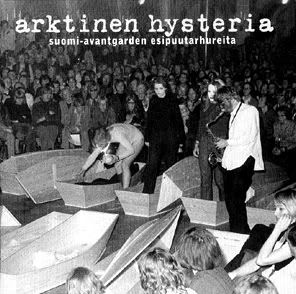
ARKTINEN HYSTERIA: SUOMI-AVANTGARDEN ESIPUUTARHUREITA


Love Records, 2001; available

13 tracks, 78:09

This absolutely priceless compilation of Finnish experimental music (the title translates roughly to "Arctic Hysteria: The Early Finnish Avant-Gardeners"!) is a tough one to review. Each track covers different styles, which makes for a delightfully diverse listen. Thus, for a change, I'm going to do a track-by-track analysis. I will provide tranlsations of the titles (when needed) in each mini-review.

1. M.A. Numminen, Tommi Parko, Pekka Kujanpää - "Eleitä kolmelle röyhtäilijälle" (1961)
This "symphony for three belchers" is probably the weakest track here, but it's mercifully brief at 1:56 and historically important. The three madmen responsible (two of whom show up with later works on the next two tracks) burp over a folky strum. That's it. Still, it's pretty funny once in a while.

2. Sähkökvartetti - "Kaukana väijyy ystäviä" (1968)
Here's where things start to get interesting! The Sähkökvartetti was a four-piece electronic instrument created by Erkki Kurenniemi (more on him later). Translating to "Electric Quartet", it consisted of an "electric violin", a primitive drum machine, a photoelectric melody machine, and the "voice machine". The latter is some kind of microphone/photoelectric aluminum stick hybrid. Numminen and Parko are on voice machine and electric violin respectively, while Arto Koskinen and Peter Widén handle melody and drum machines. This is raw live electronics,  made even eerier when Numminen's distorted voice joins the mix. The recording quality is rough, but that's perfectly suited to the material. Another version of this is on the PSYCHEDELIC PHINLAND 2-disc comp; both are recommended, since no two performances of  "Far Away Lurk Friends" were alike.

3. Tommi Parko - "Hysteriablues" (1968)
Here's Parko for a third time! This is another mildly annoying track. It consists of jazzy/bluesy piano playing while Parko yelps in a falsetto. It's too brief to REALLY grate, though, and it is very amusing. It's actually VERY similar to the experimental vocal works of Henry Flynt.

4. Erkki Salmenhaara - "Information Explosion, prologue" (1967)
I enjoy this one a lot. It's an early bit of Finnish musique concrete bordering on plunderphonics. Several different sound sources pop in and out of the mix, but rarely at the same time. The overall feeling is receiving data in bursts. Salmenhaara (with some assistance from Erkki Kurenniemi) also gets points for a fairly unique take on musique concrete.

5. Blues Section - "Shivers Of Pleasure" (1967)
While it's somewhat out of place, this psychedelic gem is really cool. Backwards tapes, free sax playing, and an "atonal choir" combine with more traditional rock to great effect. Be warned that some other Blues Section material is nowhere near as innovative.

6. Erkki Kurenniemi - "Antropoiden Tansi" (1968)
Finally getting his own track, Kurenniemi was a true electronic wizard. This track uses one of his self-built early sequencers to create an odd masterpiece. The jumpy electronic tones sound remarkably similar to later glitch and IDM experiments, earning the title "Dance Of The Anthropoids" quite well. There's not a whole lot of Kurenniemi out there, so having a taste here is quite a boon. If you're hooked like I was, try to find the collection ÄÄNITYKSIÄ/RECORDINGS 1963-1973 (and look for a review of that here soon!).

7. Jukka Ruohomäki - "Mikä aika on" (1970)
This guy was Kurenniemi's assistant. Here, he uses the DIMI (Digital Musical Instrument), a synthesizer built by you-know-who. It sounds remarkably similar to Patrick Vian's solo work and is every bit as enjoyable.

8. Jouni Kesti and Seppo I. Laine - "Vallankumouksen analyysi" (1970)
This eleven-minute onslaught of free jazz is amazing! Recorded on a cheap deck in a living room, Laine absolutely roars on alto sax while Kesti attacks his drums in a nearly grindcore fashion. At one point Laine puts his microphone inside the sax, resulting in some truly filthy distortion. I wish I could find the B-side of the mini-LP this was taken from. If it's anything like "Analysis Of Revolution" (what an absolutely fitting name!), it would be a masterpiece. As it is, this is a lost treasure of truly brutal jazz.

9. The Sperm - "3rd Erection" (1968)
Ah, the infamous Sperm! This track is taken from their debut EP. P.Y Hiltunen makes some weird vocalizations (words? sounds? speaking in tongues?) while Pekka Airaksinen does his thing with a guitar. It sounds nothing like SHH!, but it's a great track. It's somewhat comparable to a noisier take on the Holy Modal Rounders or the Fugs.

10. J.O. Mallander - "1962" (1968)
This one's important due to Mallander's involvement with the Sperm, but it's truly mind-numbing and boring. A voice repeats "Kekkonen, Kekkonen, Kekkonen, Kekkonen, Kekkonen" over and over and over. That's it. There's also a part two elsewhere that's essentially the same thing. It's a joke that works for its audience, but it loses a lot in translation.

11. The Sperm - "Kuoleman puutarha live (otteita)" (1970)
Oh man, what a find! This is basically a collage of excerpts from the Sperm's opera "Garden Of Death". It opens with a lecture, goes into an Airaksinen guitarscape via a rough cut, and then ends on a crazed jam accompanied briefly by another lecture. While it will obviously never replace seeing them live, it gives you a great idea of what the audience experienced. The cover photo of this comp is apparently from this performance, if that's any indication!

12. Pekka Airaksinen - "Pieni sienikonsertto - A Little Soup For Piano And Orchestra op 46,8" (1970)
This has already been reviewed, since it was on Airaksinen's ONE POINT MUSIC, but its presence here is definitely welcome!

13. S. Albert Kivinen - "Spirea" (1970)
Another jokey track. Kivinen sings about Spiro Agnew in an off-key voice over a folk song. It's not a standout by any stretch, but it's definitely not bad. It's probably also worth noting that Numminen shows up here yet again, this time on accordion!

Thankfully, the less-interesting tracks are all brief, while the lengthy highlights are over far too soon. This is an  excellent primer on the Finnish experimental scene(s) and should be acquired by anyone with an interest in the avant-garde. You might also want to check out SON OF ARCTIC HYSTERIA/MORE ARCTIC HYSTERIA and PSYCHEDELIC PHINLAND. The former is a 2-disc set that continues where this one leaves off, covering works from 1970 to 1990. The latter is also a 2-disc set; disc 1 is more accessible hippie/folk/psychedelic material, while disc 2 features tracks by the Sperm, Airaksinen, Sähkökvartetti, and Mallander amongst others.

Thursday, August 4, 2011

A.R. Kane, 69 and "i"


Rough Trade, 1988; reissued by One Little Indian; available

10 tracks, 40:30


Rough Trade, 1989; reissued by One Little Indian; available

26 tracks, 67:51

It never ceases to amaze me that A.R. Kane aren't well known in the US. This duo (of Alex Ayuli and Rudy Tambala) were capable of some of THE most innovative music of the late '80s. The British press saddled them with the obnoxious moniker "the black Jesus and Mary Chain", which isn't even very accurate. Their early singles were slightly JAMC-ish*, but by the time of their debut LP 69, they were mining far stranger territory. Claiming to be interpreting the style of electric Miles Davis on rock instruments, they actually hit closer to a shoegazer/dub combination that was uniquely theirs. Perhaps Cocteau Twins would be a close comparison, but A.R. Kane are far more trippy and improvisational in nature. In fact, A.R. Kane coined the term "dream pop" just to describe their music! Five of the tracks feature extra instrumentation by other musicians, but this is limited to one or two extras per track. Everything else was programmed and performed by Rudy and Alex. The opening "Crazy Blue" and "Suicide Kiss" show A.R. Kane's versatility nicely. "Crazy Blue" is shoegazer gone pop, with a catchy beat anchoring the soaring vocals of Rudy (who starts off with some interesting glossolalia) and Maggie (his sister). At the other end of the spectrum, "Suicide Kiss" has a heavy industrial-esque beat and lots of feedback; Rudy's vocals here are another perfect match with the music. Other highlights include "Sulliday", with its controlled feedback and pounding drum programming, and the particularly psychedelic "Spermwhale Trip Over" (whose main lyric is the repeated "Here, in my LSDream"!) and "Baby Milk Snatcher" (the dub influence is especially apparent here). None of these ten songs has a wasted note, and if they had released nothing but the singles and this, they still would have had an impressive catalogue.

As it happens, 1989's "i" was a bit confusing. First off, the tracklist was divided into four suites of four songs, each represented by a card suit. There were also ten "jokers" ranging from five seconds to one and a half minutes. These interludes are mostly weird bits of noise and/or atmosphere (and they mostly fall in the thirty seconds or less range), but they are fairly entertaining. The songs themselves showed Alex and Rudy tackling a wide variety of styles. To be fair, they mostly succeeded. The unusually poppy first suite has some catchy winners in "A Love From Outer Space" and "Crack Up". However, "Snow Joke" and "What's All This Then?" are obviously weaker; the former sounds too much like generic late '80s dance music, while the latter sounds like a watered-down 69 outtake. The rest of the album gets better as it goes along, with plenty of unique pop ("Miles Apart", "Sugarwings"), moody psychedelia ("Conundrum", "Honeysuckleswallow), and high-octane thrash-gaze ("Supervixens", "Insect Love"). The main duo still performs most of the music themselves, but there are more guests here than on 69. The last three tracks are very nicely sequenced. "Sorry" is five seconds of record trickery and sampled dialogue, leading into the wonderfully dubby "Catch My Drift", ending with the sarcastic six-second "Challenge". True, they somewhat overstepped their limits here, but it's still a good album.

Definitely get 69 first, but once that hooks you, "i" should find a spot in your collection as well. The follow up REM"i"XES was a little too poppy for my tastes, and 1994's NEW CLEAR CHILD is a massively disappointing comeback. There has been talk of a singles collection, which is recommended should it ever be released.

*Alex and Rudy had their big break as part of M/A/R/R/S. This collaboration with Colourbox yielded the insanely popular "Pump Up The Volume".

Monday, July 11, 2011

Noah Howard, THE BLACK ARK


Freedom, 1972; reissued by Bo'Weavil; available

4 tracks, 40:38

This legendary free jazz album is finally readily available, and boy is it a doozy! Having recorded previously for ESP-Disk', Noah Howard put together a radical septet in 1969 for THE BLACK ARK. It isn't certain why its release was delayed for three years. The other players are trumpeter Earl Cross, conga-player Juma Sultan (who also played with Jimi Hendrix), drummer Mohammed Ali (not the boxer, but drummer Rashied's younger brother), pianist Leslie Waldron, bassist Norris Jones, and the legendary Arthur Doyle on tenor sax(his debut performance!). Most of these players went on to other things, and all were obscure masters of their respective instruments. Definitely in the same category as Ayler or Takayanagi and Abe, this is jazz set to "destroy". The four tracks all begin and end with a more-or-less melodic theme; the funky "Domiabra" and Asian-tinged "Mount Fuji" (the longest tracks at 10:20 and 15:32) are most remarkable in this regard. The middles, however, all descend into noisy free-for-alls. Howard and Cross are every bit as riotous as Doyle, and each man's solo involves lots of shrieking and honking. The rhtyhm section holds its own nicely. Waldron attacks the piano in a percussive manner, while Ali manages to provide furious pounding and blasting or restrained rolling according to the other players' whims. Juma's conga adds another layer of strangeness, with its trippy delay effect creating a unique sound. The Bo'Weavil CD issue comes housed in a very nice thick card sleeve, almost like a mini-LP, with an inner sleeve for the CD itself; it's also available on vinyl. The reporduction of the orginal liner notes plus new commentary by Oren Ambarchi adds to the overall wonder of this album. If you're at all interested in free jazz, you probably need this and I heartily recommend it. I will even go on record saying I enjoy this one album far more than ANYTHING Ayler recorded!

Monday, May 23, 2011

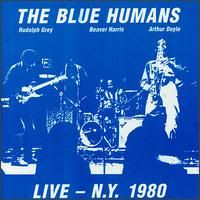
The Blue Humans, LIVE - N.Y. 1980


Audible Hiss, 1995; out of print

4 tracks, 68:50

Here's a recipe for you. Add two parts free jazz to one part no wave. Place the ingredients on a stage; let them boil for approximately sixty-nine minutes. This recipe yields one copy of this album.

Recorded live at Hurrah on March 12, this is the earliest document of Rudolph Grey's Blue Humans. Grey was no stranger to the underground; he had teamed up with Von LMO (in Red Transistor and Why You Murder Me) and Mars, providing his noisy guitar textures and occasional barked vocals. He had also performed with drummer Beaver Harris in a duo setting. Harris had an impressive resume, gracing sessions by Ayler, Shepp, and others. These duos were some of the first performances using the Blue Humans monkier (a few earlier performances featured a duo of Grey and percussionist Rashid Baker). Along the way, Grey had discovered/become a fan of Arthur Doyle; in fact, Grey was present at the Doyle show which was released as ALABAMA FEELING. Previously reviewed on this blog, Doyle's reed playing is absolutely in a class of its own. The review quoted by Grey in the liners describes Doyle as "dangerous" and "nasty"; no wonder Grey was intrigued! The three came together around 1980, bringing their crazed free jazz to post-punk audiences. On this particular night, all three players are in top form. Harris can provide a light atmospheric backing or the full-on clanging and bashing usually associated with this music. Either way, he never settles down, providing a near-constant percussive backdrop for Grey and Doyle. The former shows remarkable restraint; clearly Rudolph respected his fellow players, for his feedback-drenched strumming and slashing meshes perfectly with the others. That leaves Doyle, who goes about as crazy as you'd expect! Doubling on tenor sax and flute, Doyle's shrieks and flutters are always perfect. Fans of his ALABAMA FEELING or Noah Howard's THE BLACK ARK certainly won't be disappointed! Interestingly, there are several points over the long "tracks"* where one or more players will duck out to allow the others to shine. Mostly this involves Doyle and Grey leaving room for the other, but there are several points (in the third track, especially) where it's just Doyle and his horn. The recording quality is pristine; if it wasn't for the enthusiastic applause you wouldn't think it was live! This is yet another gem which has been allowed to go out of print; it's also quite hard to find for under $20. If you have even a passing interest in truly outrageous free jazz, the no wave scene, or the early days of punk/jazz fusion, I suggest you make the effort to get this.

Doyle would leave for France, briefly replaced by Charles Tyler. Grey and Doyle still collaborate to this day, though the Blue Humans seem to have fallen by the wayside. In particular, Grey's TRANSFIXED features a stunning Doyle performance, while the Arthur Doyle Quartet's LIVE AT THE COOLER documents Doyle, Grey, bassist Wilbur Morris, and drummer Tom Surgal in a particularly fiery '95 show. Other Blue Humans lineups have included Surgal, Alan Licht, Rashied Ali, Charles Gayle, and Jim Sauter. Particularly interesting is their sole studio album, CLEAR TO HIGHER TIME (with Licht and Surgal). Harris also appears on the Blue Humans' INCANDESCENCE (with Grey and Sauter; also highly recommended). He kept playing free jazz until his death in 1991.

*None of the tracks have names, and the four indexed have times of 21:02, 6:44, 29:46, and 11:15.

Friday, May 20, 2011

The Gordons, 1ST ALBUM AND FUTURE SHOCK E.P.


Flying Nun, circa 1997 (sources vary for the compilation's release; see review for original release dates); available

10 tracks, 50:43

New Zealand has long been a hotbed for alternative music (when that term actually meant something). The Gordons emerged from this fertile scene, armed with homemade guitars and noisy ambitions. Originally comprised of bassist John Halvorsen, guitarist Alistair Parker, and drummer Brent McLaughlin, the Gordons were an unstoppable post-punk delight. The FUTURE SHOCK EP came first (1980, on their own Gordons label). The title track and "Adults and Children" are noise rock gems, combining ferocious drumming and driving basslines with distorted guitar blasts and Halvorsen's frenzied shout-sing vocals. The slow Parker-sang "Machine Song", which is no less amazing, is much more like their debut LP. Released in 1981 on Gordons, this was a seven song masterpiece. Opener "Spik and Span" starts out mellow and beautiful, turning into a frenzied rave-up towards the end. This is followed by the nearly nine-minute "Right On Time", which in a more-just world would be universally considered a classic post-punk epic (the vocals here sound uncannily like Peter Murphy!). The rest of the tracks veer from humorous sludgy rock ("Coalminer's Song", "Growing Up") to post-punk rave-ups ("Sometimes", "I Just Can't Stop"), ending with the remarkable distortion-heavy "Laughing Now". It's strange listening to them now; Sonic Youth and Live Skull seem to have picked up a few ideas from the Gordons, and if it wasn't for the NZ accents you'd think these songs came out of mid-eighties New York. Fans of SY, Live Skull, Dinosaur Jr., etc.: This is the missing piece of your collection. Acquire this at all costs; you can typically get it from Flying Nun or another reliable New Zealand-based retailer for around $17 US (that's INCLUDING shipping).

If you just wanted to read the review, you can stop here. The following is a somewhat complicated mini-history of the Gordons after these albums.

After FUTURE SHOCK and THE GORDONS, Parker left. Vince Pinker took over bass duties, and this lineup recorded GORDONS II. Curiously, GORDONS II has never been reissued (it seems to be pretty much disowned by the band), but this compilation uses a slight variation of its cover art. Both original covers are reproduced on the back and in the delightfully wacky collage-ridden booklet. After GORDONS II, they split up. In the meantime, Parker had formed Bailter Space. After the atypical-sounding NELSH BAILTER SPACE EP, Halvorsen joined up for the LP TANKER. By the second LP, THERMOS, McLachlan was drafted on drums, thus bringing everything full circle! Anything by Bailter Space is well worth investigating.